Introduction
If you’ve spent any time learning SEO, you’ve probably come across the term “keyword density” and wondered what it actually means. It sounds technical, but it’s actually a simple idea once you break it down. In this article, we’ll walk through everything you need to know about keyword density, why it matters, and how to use it the right way without hurting your rankings.
What Is Keyword Density?
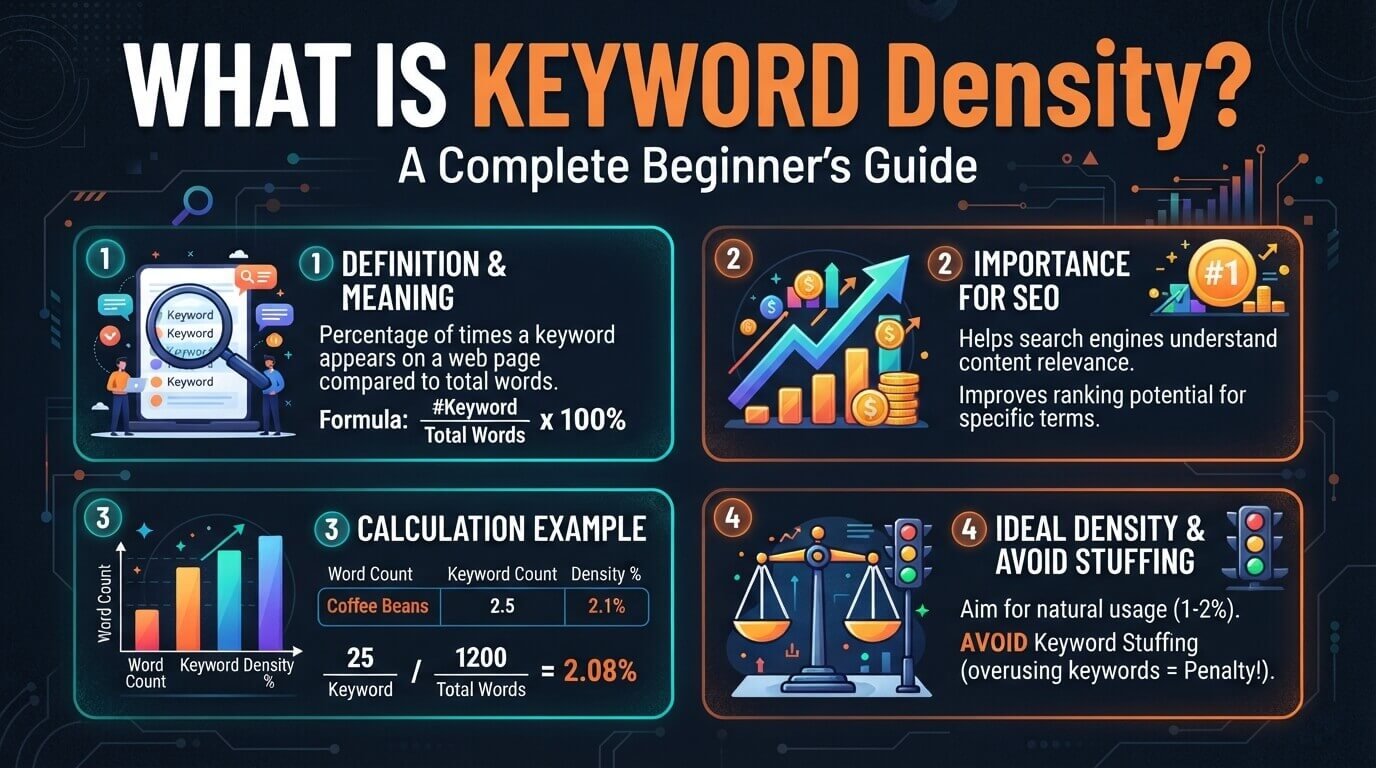
Keyword density is the percentage of times a specific word or phrase appears in a piece of content compared to the total number of words in that content. For example, if you write a 1,000-word article and your focus keyword appears 10 times, your keyword density is 1%. It’s a simple math formula, but understanding what it means for your content strategy takes a bit more thought.
Why Keyword Density Matters in SEO


Search engines like Google read your content to figure out what it’s about. Keyword density used to be one of the main signals search engines relied on. While it’s not as powerful as it once was, it still plays a small role in helping search engines and readers understand your topic clearly. If your focus keyword never appears, your content may seem unrelated to what people are searching for. If it appears too often, your content can feel repetitive and spammy.
How Keyword Density Is Calculated
The formula is straightforward. You take the number of times your keyword appears, divide it by the total word count, and multiply by 100. So if your keyword appears 8 times in a 500-word article, your density is 1.6%. Most keyword density checker tools calculate this automatically, so you don’t need to do the math by hand, but understanding the formula helps you know what the tool is actually telling you.
The Ideal Keyword Density Percentage
There’s no single magic number, but most SEO professionals agree that a density between 1% and 2% is a safe and natural range. This means your keyword appears often enough to signal relevance without overwhelming the reader. Going above 3% starts to feel forced, and search engines may flag it as an attempt to manipulate rankings rather than genuinely help the reader.
Keyword Density vs Keyword Stuffing
This is where many beginners get confused. Keyword density is healthy and natural. Keyword stuffing is the unnatural overuse of a keyword in a way that makes the content hard to read. For example, writing “our keyword density checker is the best keyword density checker for checking keyword density” is keyword stuffing. It repeats the same phrase in a way no real person would ever write or enjoy reading.
How Search Engines View Keyword Density Today
Modern search engines are far smarter than they used to be. Google now uses advanced language models to understand context, meaning, and intent, not just exact word matches. This means you don’t need to repeat your keyword an exact number of times to rank well. Instead, search engines reward content that genuinely answers the reader’s question, uses related terms naturally, and reads smoothly from start to finish.
Primary Keywords vs Secondary Keywords
Every strong article has one primary keyword and a handful of secondary or related keywords. Your primary keyword is the main topic, like “keyword density” in this article. Secondary keywords might include terms like “keyword stuffing,” “SEO content,” or “keyword density checker.” Using a mix of these naturally throughout your writing helps search engines understand your content in a deeper, more complete way than repeating just one phrase over and over.
How to Check Your Keyword Density

Checking your keyword density is easy with the right tool. You simply paste your article into a keyword density checker, enter your focus keyword, and the tool instantly shows you the percentage along with a list of other frequently used words. This gives you a clear picture of whether your content is balanced or needs adjusting before you publish it.
Common Mistakes with Keyword Density
One of the biggest mistakes writers make is obsessing over an exact keyword count instead of focusing on quality. Another common mistake is ignoring keyword placement entirely, hoping that quantity alone will help rankings. A third mistake is using the keyword in a way that feels awkward or grammatically incorrect just to fit it in more times.
Keyword Density and Readability
Readability should always come first. If adding your keyword one more time makes a sentence confusing or unnatural, it’s not worth it. Readers stay longer on pages that flow well and feel human. Search engines track user behavior like time on page and bounce rate, so content that keeps readers engaged often performs better than content that technically hits a perfect density score but reads poorly.
Using LSI and Related Keywords
LSI stands for Latent Semantic Indexing, and it simply refers to words and phrases that are related to your main topic. Instead of repeating “keyword density” constantly, you can use related terms like “keyword frequency,” “SEO word balance,” or “content optimization.” This approach feels more natural and also helps search engines understand the full context of your article.
Keyword Density in Titles and Headings
Your focus keyword should appear in your title and at least a few of your subheadings, including this article’s own structure. This helps both readers and search engines quickly understand what the page covers. However, you don’t need to force it into every single heading. A few well-placed mentions are enough.
Keyword Density in Meta Descriptions

Your meta description is the short snippet that appears under your title in search results. Including your focus keyword here, in a natural sentence, can improve your click-through rate because it shows searchers that your page matches what they’re looking for.
Tools to Measure Keyword Density
There are many free and paid tools available for checking keyword density, including dedicated keyword density checkers, broader SEO platforms, and simple browser extensions. The best tool for you depends on your budget and how often you plan to check your content, but even a basic free checker is usually enough for most writers and small website owners.
Keyword Density Best Practices for 2026
Focus on writing for humans first. Use your keyword naturally, include related terms, keep your sentences clear, and structure your content with helpful headings. Avoid repeating the exact same phrase excessively, and always prioritize answering the reader’s question over hitting a specific percentage.
A balanced keyword density, paired with genuinely useful content, is still one of the simplest and most effective SEO habits you can build.
Final Thoughts
Keyword density is a useful guide, not a strict rule. It helps you check that your content stays focused and relevant without becoming repetitive or unnatural. The real goal is always the same: write something genuinely helpful, use your keyword and its related terms where they fit naturally, and let good writing do the rest of the work.
1 thought on “What Is Keyword Density? A Complete Beginner’s Guide”