Introduction
you click links all day without thinking, but have you noticed the words you click? Those words are not random. They tell you, and search engines, what to expect on the next page. If you have ever asked what is anchor text in seo, you are in the right place. In this guide, you will learn what is anchor text in seo, how the different types work, and how to use it in a safe and natural way, all in simple words.
What Is Anchor Text in SEO?
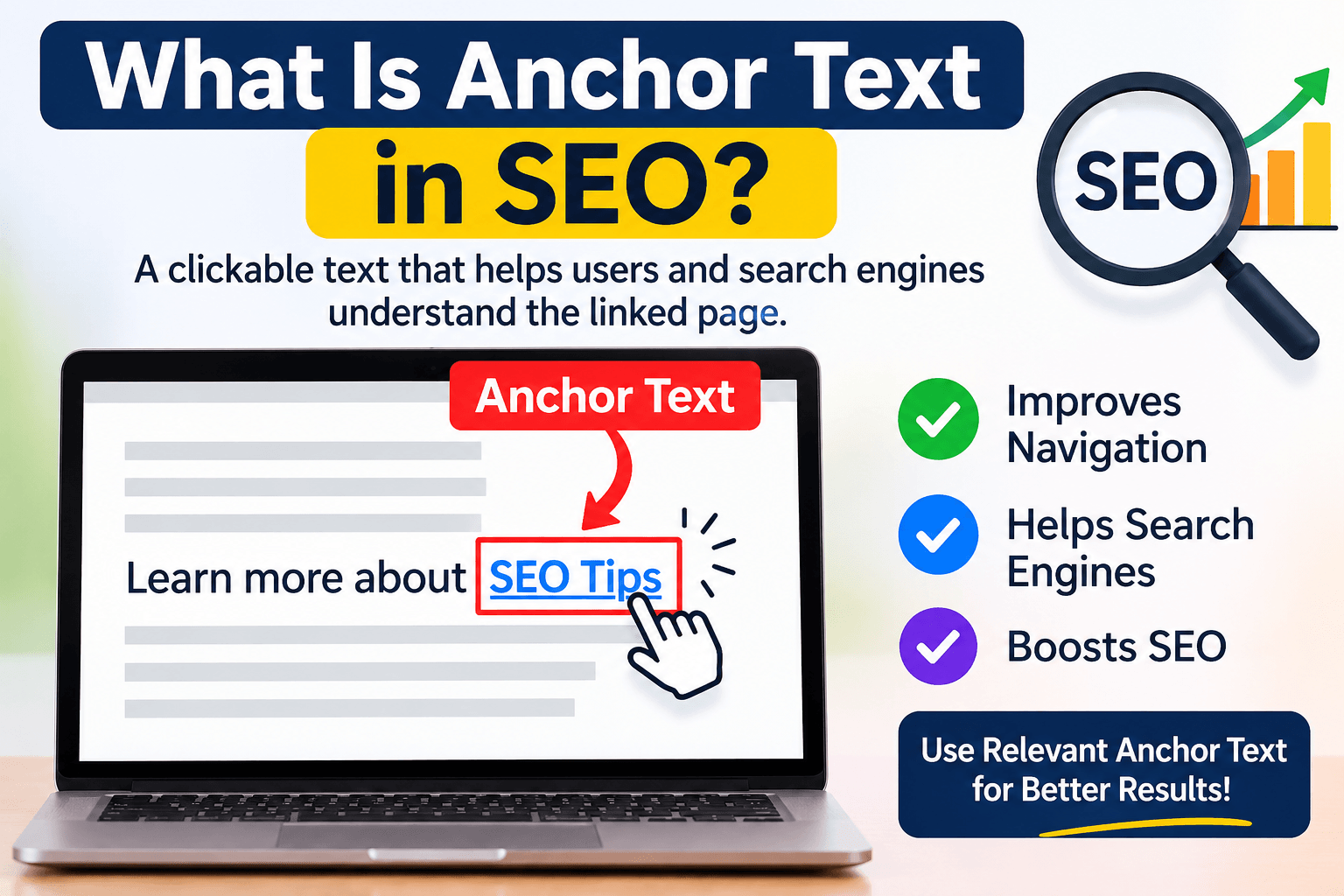
Anchor text is the clickable text of a link. When you see blue underlined words on a page and click them to go somewhere else, those words are the anchor text. So, what is anchor text in seo? It is the same thing, but looked at from a search point of view. The words you choose give hints about the page you link to. They help readers decide whether to click, and they help search engines understand the topic of the linked page. That is why they matter.
What Is Anchor Text in SEO? A Simple Example
Imagine you write a sentence: “Read our guide to keyword density for more details.” If the words “keyword density” are linked to a page, then keyword density is the anchor text. The reader can guess that the page is about keyword density. A search engine can guess the same. Now compare this with “Click here.” These words say nothing about the page. The link works, but it gives less information. A good anchor is short, clear, and tells the truth about the page.
What Is Anchor Text in SEO and Why Does It Matter?
Anchor text matters for two groups of people. For readers, it explains where a link goes, so they can choose with confidence. For search engines, it gives context about the target page, and it helps them find related pages on your site. Google has said that it uses links and the text around them as signals. Good anchors also make your content easier to read and easier to use. A page with clear, helpful links feels organized, and visitors can move around without getting lost.
How Search Engines Use Anchor Text
Search engines follow links to find new pages and to understand how pages connect. The anchor text acts like a small label on each link. If many pages link to a page with similar words, it can show what that page is about. Search engines also look at the words around the link, not only the anchor itself. Because of this, a natural sentence with a helpful link is better than a forced phrase. No one knows the exact formula, so write for people and let the signals follow.
Types of Anchor Text
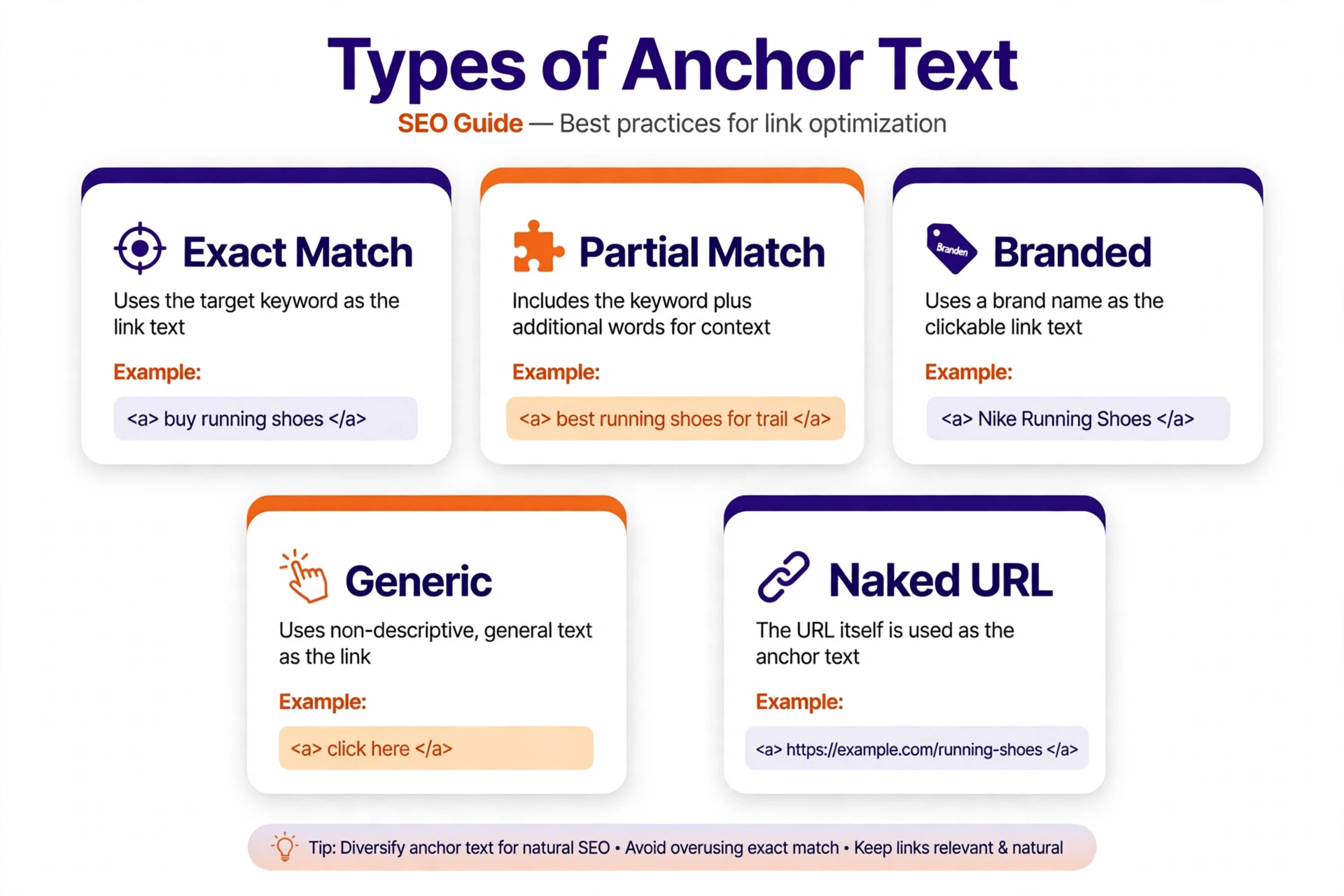
There are several common types. Exact match anchors use the exact keyword, such as keyword research tool. Partial match anchors use the keyword with other words, such as a simple guide to keyword research. Branded anchors use a brand name, such as the name of your company. Generic anchors use words like click here or read more. Naked URL anchors show the web address itself. Image anchors are images that carry a link. A healthy site usually has a natural mix, because real people link in many different ways.
Exact Match and Partial Match Anchors
Exact match anchors can be helpful, but they are easy to overuse. If every link to your page uses the same exact keyword, it can look unnatural, especially for backlinks from other sites. Google’s spam policies warn against link schemes that try to manipulate rankings, and keyword-stuffed anchor text in such links is one example. Partial match anchors are usually safer and more natural, because they add extra words and read like normal writing. Use exact match when it truly fits the sentence, and mix in variations.
Branded, Generic, and Naked URL Anchors
Branded anchors build recognition and are very natural for backlinks. Generic anchors, such as click here, are common, but they say little and are not good for accessibility, so avoid them in your own content. Naked URLs show the full address, such as example.com, and they are fine in some cases, like a reference list, but they look messy in the middle of a sentence. A good rule is to use descriptive text for your own links, and accept that other sites will link to you in many different ways.
Image Links and Alt Text
When an image is linked, search engines use the image’s alt text as something like anchor text. So alt text should be a short, honest description of the image and the link’s purpose. For example, if a logo links to the home page, the alt text can be the site name. Do not stuff keywords into alt text. It is meant to help people who cannot see the image, such as screen reader users, and to give clear information to search engines. Clear, simple alt text is the best choice.
Internal Links and Anchor Text
Internal links connect pages on your own site, and you control their anchor text fully. This is a great place to use clear, descriptive anchors. When people ask what is anchor text in seo and how to use it first, the answer is usually internal links, because they are safe and helpful. Link from related pages to your important pages, use short descriptive phrases, and vary the wording a little. Do not link the same exact phrase to many different pages, because it confuses readers and search engines.
Backlinks and Your Anchor Text Profile
Backlinks are links from other websites to yours, and you cannot fully control the anchor text. Other writers choose it, and that is a good thing, because natural variety is a healthy sign. Your anchor text profile is the mix of all anchors pointing to your site. A natural profile has many branded anchors, URLs, partial matches, and generic words, with only some exact matches. If you build links, never pay for them or trade them in large numbers, because that can break search engine rules. Earn links by making helpful content.
How to Write Good Anchor Text Step by Step
First, think about what the reader will find on the linked page. Second, choose a short phrase that describes it, usually two to six words. Third, place the link in a sentence that makes sense on its own. Fourth, make sure the anchor text matches the page. Fifth, vary your wording from page to page. Sixth, read the sentence out loud to check it sounds natural. If you follow these steps when you wonder what is anchor text in seo and how to write it, your links will help both people and search engines.
Anchor Text and Accessibility
Many people use screen readers that can list all the links on a page. If your links all say click here, the list makes no sense. Descriptive anchors solve this and make your page easier for everyone. Also avoid very long anchors, because they are harder to read and to click. Make links visible, with a clear color or underline, so readers know what is clickable. Good link text is part of good writing and good user experience, not only an SEO trick.
Examples: Weak and Strong Anchors
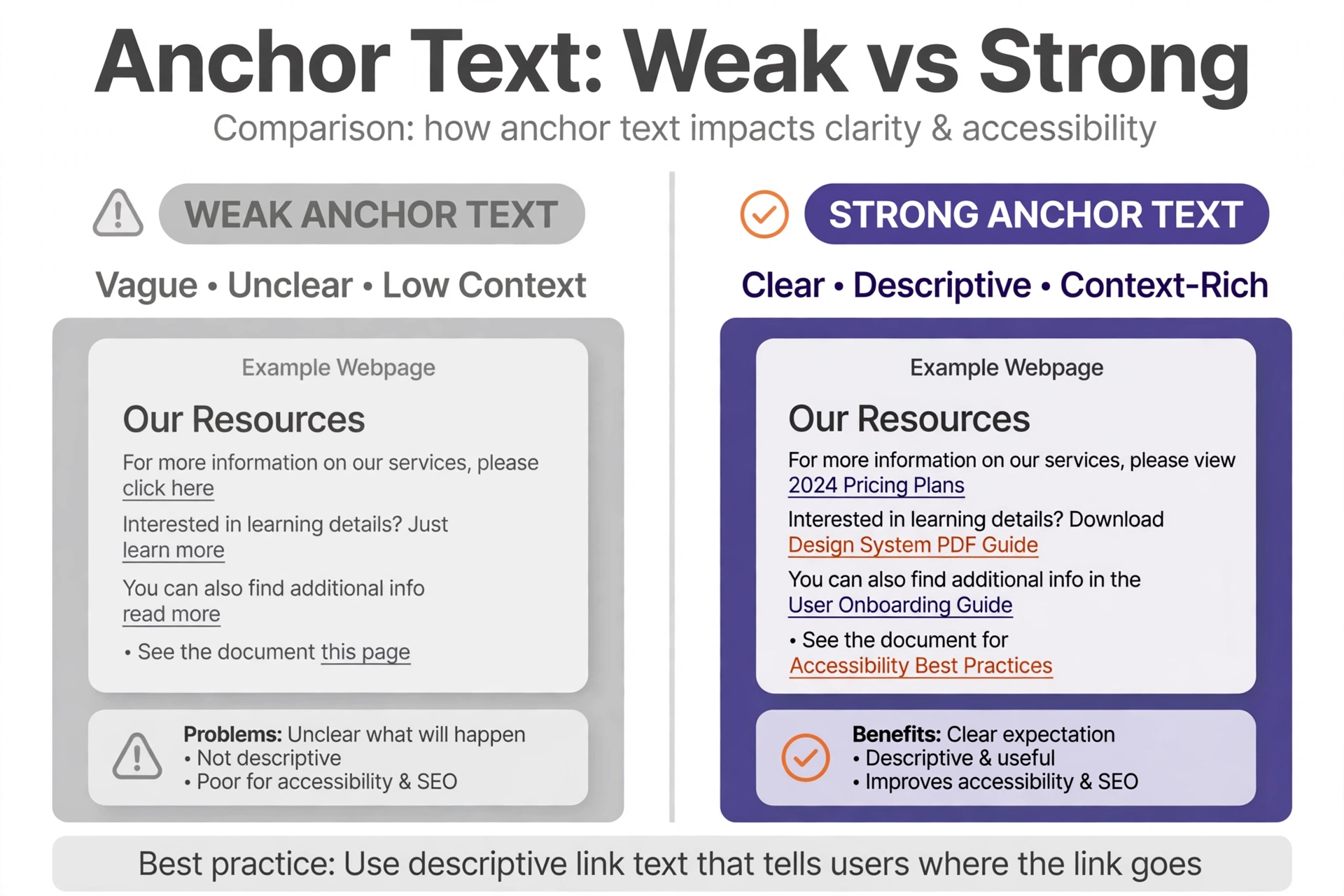
A weak example is: “For tips, click here.” A better version is: “See our beginner guide to keyword research for simple tips.” The second one tells the reader what to expect, and it adds useful words without sounding forced. Another weak example is a long sentence turned into a link, which is hard to read. A strong one is
hort and clear, such as “internal linking guide.” Notice that the best anchors read like normal language, because they were written for people first.
How to Check Your Anchor Text
You can check your own anchor text by reading your pages and looking at each link. Many SEO tools can list internal links and the anchor words used. For backlinks, Google Search Console has a links report that shows the top linking text, which helps you see how others describe your site. Look for odd patterns, like one exact phrase repeated too often, or many empty anchors. When you wonder what is anchor text in seo for your site in practice, these reports show you the real picture.
Common Mistakes
The first mistake is using click here and read more everywhere. The second is using the same exact keyword for every link. The third is writing very long anchors. The fourth is linking to pages that do not match the anchor text. The fifth is buying links with keyword-rich anchors. The sixth is forgetting to update links when a page changes. Avoiding these mistakes shows that you understand what is anchor text in seo and how to use it responsibly.
Tips for Better Results
Link to helpful pages only, not to every page. Use anchors that describe the page in plain words. Place important links near the top of the content, where readers see them. Update old posts with new internal links to fresh pages. Fix broken links. Vary your anchors without making them strange. Keep your links few and useful. These simple habits help your site feel organized, and they show that you know what is anchor text in seo and why quality beats quantity.
Quick Checklist
Before you publish, go through a short check. Does every link have clear, descriptive text? Does each anchor match the page it points to? Did you avoid click here and naked URLs in your own content? Did you vary the wording of anchors? Do your links help the reader? Did you test every link? If you can say yes to each question, you understand what is anchor text in seo well enough to use it in your daily writing, and your page is ready.
Final Answer: What Is Anchor Text in SEO?
In short, anchor text is the clickable words of a link, and it tells readers and search engines about the page behind it. Use clear, short, natural anchors. Mix your wording, link to useful pages, and never try to trick search engines. When you write links for people first, you get both a better reading experience and healthier signals for search. That is the simple, honest answer to what is anchor text in seo.