Why Keyword Difficulty Explained Simply Helps Beginners
Every new blogger has the same dream: write a great page and see it on the first page of Google. The problem is that some phrases are much harder to win than others, and picking the wrong one can waste months of work. That is why keyword difficulty explained in plain words is so useful for beginners.
It shows you how crowded a search is before you spend time writing. Think of it like choosing a race. A small local race gives you a fair chance, while a huge national race is full of experts. With keyword difficulty explained clearly, you can choose races you can win, and you can build confidence one small victory at a time.
What Is Keyword Difficulty?
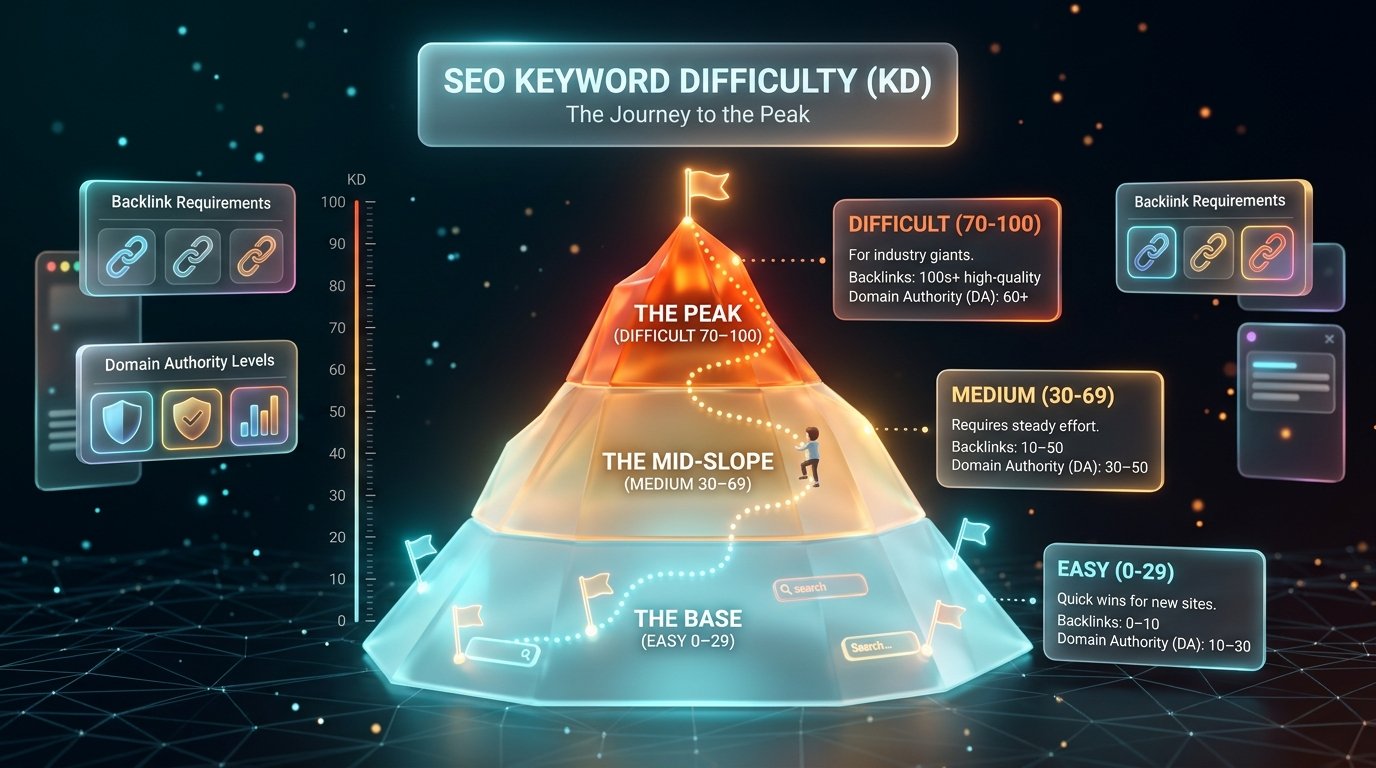
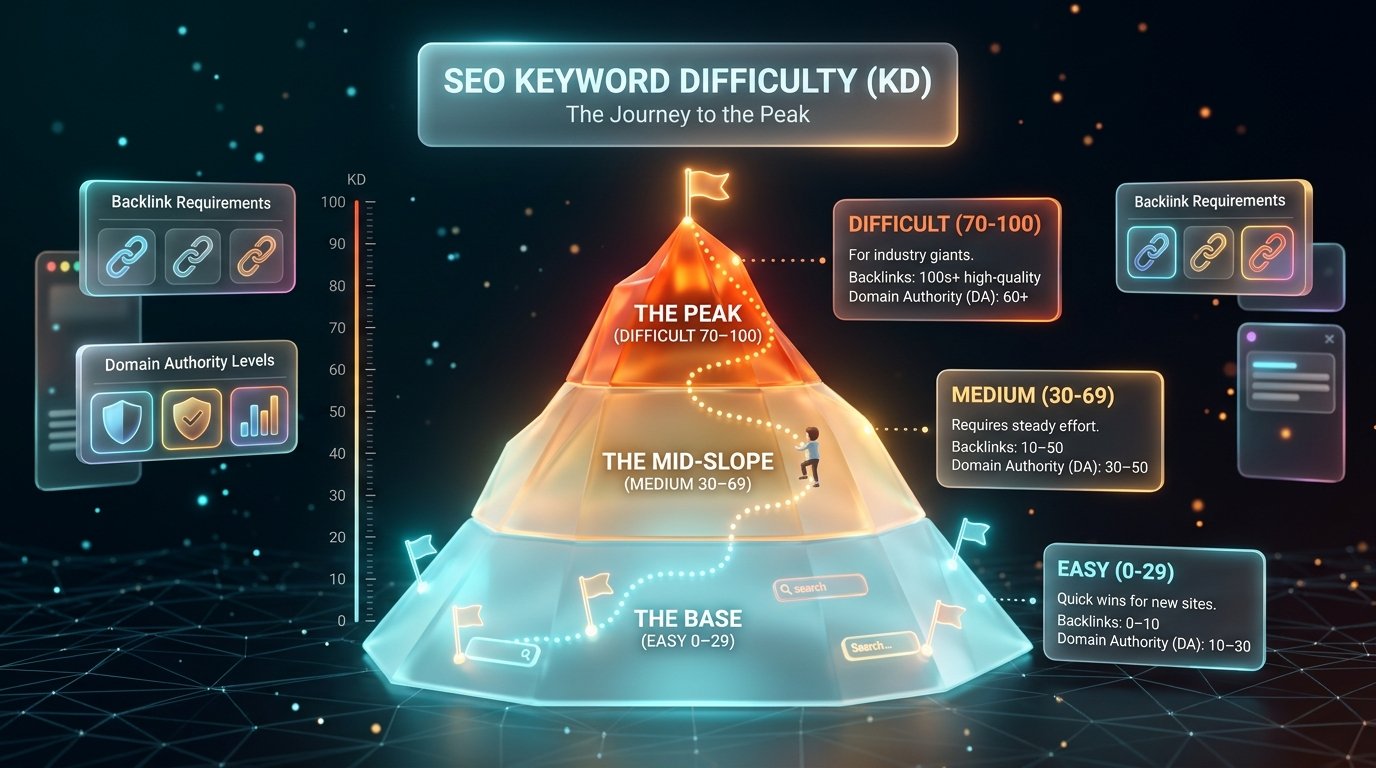
Keyword difficulty is a score that tries to show how hard it would be to reach the first page for a search phrase. Most tools show it as a number from 0 to 100, where a low number means an easier phrase and a high number means a harder one. It is not a rule from Google, and no search engine publishes it.
It is an estimate made by SEO tools, based on what they can measure about the pages that already rank. Keyword difficulty explained in one sentence is this: it is a guess about how strong your competition is, and it helps you choose where to start.
Keyword Difficulty Explained in Plain Words
Imagine you want to open a small tea stall. If you open it on a street with ten big famous tea shops, it will be very hard to get customers. If you open it on a quiet street with no tea shop, customers will find you easily. A search phrase works the same way. Some phrases already have many strong websites with a lot of trust, long articles, and many links.
Others have only a few weak pages. Keyword difficulty explained like this means you are really measuring the crowd and the strength of the shops, so you can decide if you have a fair chance. This simple picture makes the idea easy to remember.
How Tools Calculate the Score
Most tools look at the pages that currently rank on the first page for a phrase. They check how many other websites link to those pages, how strong those sites are, and sometimes how complete the content is. Then they turn all of this into one number. If the top pages have many strong links, the score goes up.
If the top pages are weak and have few links, the score stays low. Every tool uses its own method and its own secret formula, so the numbers are not the same everywhere. This is an important part of keyword difficulty explained correctly, because the score is only a model and not a fact.
Keyword Difficulty Explained: Low, Medium, and High Scores
A low score, often under thirty, usually means the competition is light, and a good page from a new site might have a chance. A medium score, roughly thirty to sixty, means you will need strong content, good links, and some patience. A high score, above sixty or seventy, usually means strong websites dominate, and a new site will find it very hard to compete.
These ranges are rough guides, because each tool draws the lines in a different place. Keyword difficulty explained in this way gives you a simple way to sort ideas into easy, medium, and hard groups, so your content plan becomes less confusing.
Why Different Tools Show Different Numbers
You may enter the same phrase into two tools and see two different scores. This is normal. One tool may focus mostly on links, another may add content quality, and another may use a different list of pages and links. Each tool also has its own data, collected at different times.
Because of this, you should not treat one number as the truth. Use the same tool when you compare phrases, so the scores follow one method. Keyword difficulty explained honestly means saying that a score is a helpful guide and never a promise, and comparing phrases inside one tool is far more useful than comparing numbers across tools.
Keyword Difficulty Explained for New Websites
A new website has very little trust, so it should avoid phrases where big, old, strong sites rule. Start with phrases that have low scores, clear intent, and a topic you know well. Each page that reaches a good position builds a little trust for your site, and that trust makes the next page easier.
This is the best way to think about keyword difficulty explained for new websites: begin with easy wins and move slowly toward harder phrases as your site grows. Do not be sad if your first pages target small phrases. Many strong websites started this way, and patience is part of the plan.
How to Check Difficulty by Hand
You do not need paid tools to get a feel for difficulty. Search the phrase yourself and look at the first page. Who ranks? If you see huge brands and famous news sites, the phrase is probably hard. If you see small blogs, forums, or simple pages, the door may be open. Open the top pages and check how deep and useful they are.
Are they old? Are they short? Do they answer the question fully? A quick manual look is a smart part of keyword difficulty explained, because it shows you things that a score cannot show, like weak content or outdated answers that you could easily improve.
Keyword Difficulty Explained With Search Intent
A low score does not help if your page does not match what the searcher wants. Intent means the reason behind the search, such as learning, comparing, or buying. If the top results are guides and you write a sales page, you will struggle, even with an easy phrase. Always check what kind of pages Google shows, and match that type.
Keyword difficulty explained without intent is only half the story, because a phrase can look easy and still be hard if the wrong content type is used. When difficulty and intent both fit your page, your chances grow a lot.
Difficulty vs Search Volume
Search volume tells you how many people search for a phrase, and difficulty tells you how hard it is to rank. Many beginners chase high volume, but high volume usually comes with high difficulty, because everyone wants the same traffic. A phrase with few searches and low difficulty may bring fewer visitors, but they are easier to win and often more focused.
A good plan mixes both numbers and also asks if the phrase fits your page. Think of volume as the size of the prize and difficulty as the strength of the other runners. You need to look at both before you decide to enter the race.
Keyword Difficulty Explained With Real Examples
Look at an example. The phrase “audio” is a short and very popular word, so thousands of strong pages compete for it, and the difficulty is very high. The phrase “best microphone for podcasting at home on a small budget” is long and specific, with fewer pages and a much lower difficulty. A new site has a better chance with the second one.
Another example is a very broad phrase like “SEO,” which is almost impossible for a small site, compared with “how to read Google Search Console queries,” which is narrow and easier. These examples show keyword difficulty explained in daily life, where specific phrases usually beat broad ones for small sites.
How to Pick Easier Keywords
To find phrases with lower difficulty, start with longer, more specific searches. Look for questions that real people ask, because big sites often ignore them. Use the “people also ask” box and search suggestions for ideas. Add details like a place, a type of user, or a problem to a broad phrase.
Check the first page by hand, and look for weak pages that you can beat. Choose phrases where you have real knowledge or experience, because personal details make content stronger. Keyword difficulty explained in a practical way means turning big, hard phrases into small, friendly ones, and then writing the best page you can for each of them.
Keyword Difficulty Explained for Long Tail Phrases
Long tail phrases, which have three to six words, usually have lower difficulty because fewer sites target them. They also show clearer intent, so the visitors who arrive are more likely to find what they need. For a small site, a group of long tail pages can bring steady traffic even when each one has modest volume.
Over time, they also help you grow strength in a topic. Keyword difficulty explained for long tail phrases is a simple story: small, specific searches are easier, and many small wins add up. Build a list of such phrases, group them by topic, and write one clear page for each group.
Common Mistakes to Avoid
The first mistake is trusting a single number without looking at the real results. The second is chasing high volume and ignoring difficulty. The third is picking easy phrases that do not match your topic or your readers. The fourth is ignoring search intent. The fifth is giving up too soon, since new pages need time.
The sixth is using many different tools and comparing their numbers. Most mistakes come from treating the score as a promise, when it is only a guide. Slow down, look at the real search results, and use your own judgment together with the data.
Keyword Difficulty Explained: A Simple Action Plan
Here is an easy plan. First, list ten phrases for your topic. Second, check their difficulty in one tool, and mark them as easy, medium, or hard. Third, search each phrase by hand and look at who ranks. Fourth, check the intent and decide what type of page is needed. Fifth, pick two or three easy phrases that fit your site, and write strong pages for them.
Sixth, track results in Search Console after a few weeks. This is keyword difficulty explained as a routine, and it works for blogs, shops, and small business sites alike.
Frequently Asked Questions About Keyword Difficulty Explained
People often ask what score is good. For a new site, lower scores are safer, but the right number depends on the tool and your site. Others ask if difficulty is an official Google score. It is not. Many ask if a hard phrase can ever be won. It can, but it needs strong content, links, and time.
Some ask if the score changes. Yes, as pages and links change. A clear idea of keyword difficulty explained answers most worries. If you are unsure, test with a few easy phrases first, and use keyword difficulty explained as a guide to move step by step toward bigger goals.