Introduction
Understanding keyword usage is an important part of creating helpful and search-engine-friendly content. When writing a blog post, website page, or online article, you need to know how often your target keyword appears and how much space it takes up in your content. This is where keyword density and keyword frequency become useful.
Although these two SEO terms sound similar, they measure different things. Keyword frequency tells you how many times a particular keyword appears in a piece of content, while keyword density measures the percentage of total words made up by that keyword.
Understanding keyword density vs keyword frequency can help bloggers, website owners, and content writers improve their writing without repeating keywords unnecessarily. In this guide, we will explain both concepts, show their differences, provide simple examples, and discuss how to use them effectively.
1. What Is Keyword Density?
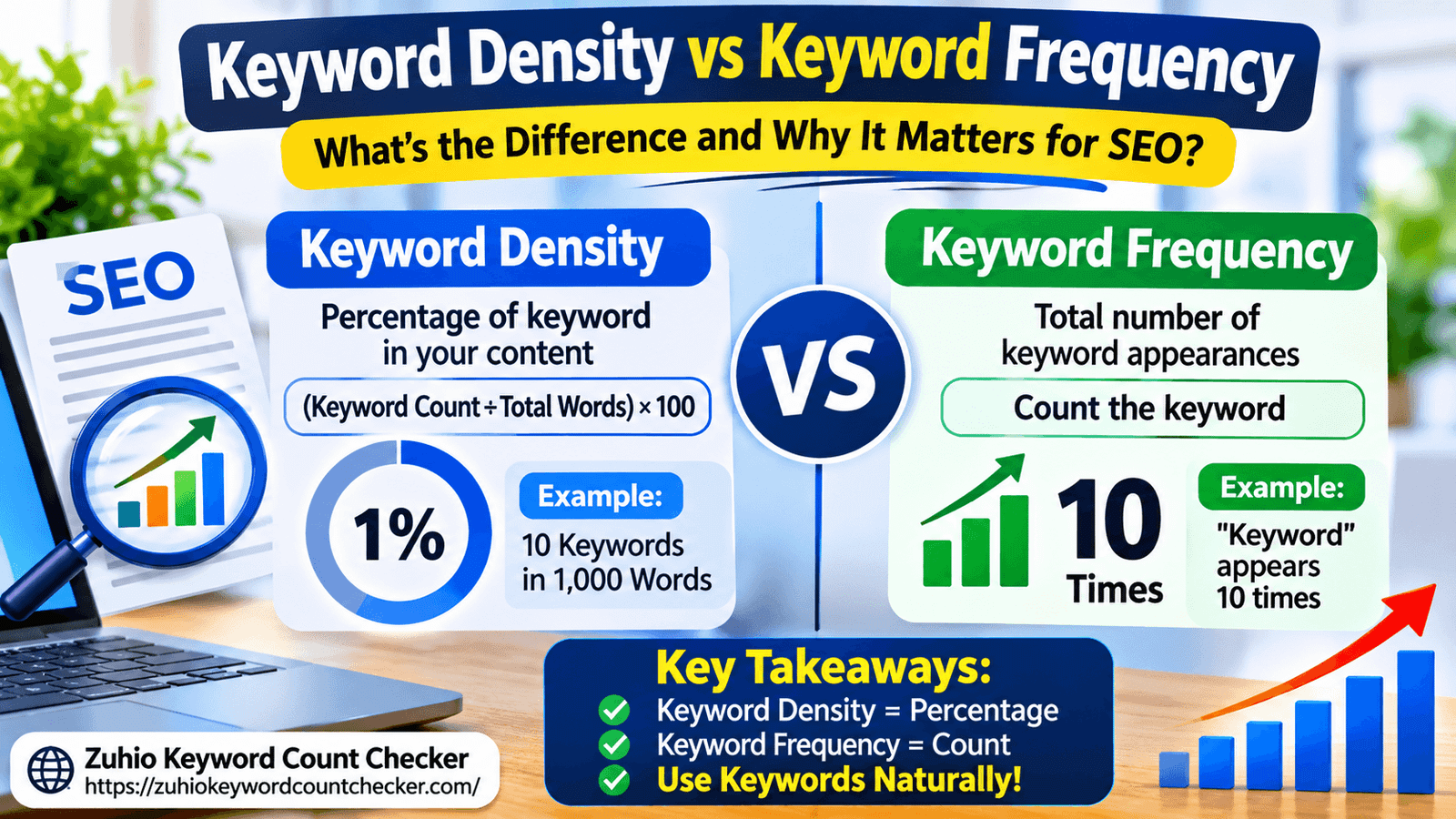
Keyword density is the percentage of times a particular keyword appears compared with the total number of words in a piece of content. It helps writers understand how frequently a target keyword is used in relation to the overall article length. For example, if your article contains 1,000 words and your focus keyword appears 10 times, its keyword density is 1%.
This measurement can help you review your content and identify excessive repetition. However, keyword density should not be treated as a fixed ranking rule. Search engines consider many factors when understanding a page, including its meaning, usefulness, structure, and relevance to the search query.
2. What Is Keyword Frequency?
Keyword frequency refers to the total number of times a specific keyword or phrase appears in your content. It is a simple way to count keyword appearances without considering the total word count.
For example, if the phrase “keyword research tool” appears 15 times in a blog post, its keyword frequency is 15. This information is useful for content writers who want to check whether they have included their main topic throughout an article. Keyword frequency can also help identify repeated words and phrases that may make content sound unnatural. Using an online keyword count checker makes this process faster and easier.
3. Keyword Density vs Keyword Frequency: Main Difference
The main difference between keyword density vs keyword frequency is the way each measurement works. Keyword frequency counts the number of keyword appearances, while keyword density calculates those appearances as a percentage of the total word count. For example, imagine two articles that both use a focus keyword 10 times.
The first article contains 500 words, while the second contains 2,000 words. Both articles have the same keyword frequency, but their keyword densities are different. This shows why understanding both measurements is useful when reviewing SEO content. One tells you the number of repetitions, while the other explains how common the keyword is compared with the article’s length.
4. Why Keyword Density Matters for SEO
Keyword density can help writers understand whether a particular term appears too frequently or too rarely in their content. It provides a simple way to review keyword distribution and identify possible overuse. When a keyword is repeated too many times, the article may become difficult to read and sound unnatural.
On the other hand, using a relevant keyword naturally can help readers and search engines understand the subject of a page. However, there is no universal keyword density percentage that guarantees higher Google rankings. Instead of trying to reach a specific number, focus on writing useful information that answers the reader’s questions.
5. Why Keyword Frequency Is Important
Keyword frequency is useful because it gives writers a clear count of how many times a search term appears in an article. This is particularly helpful when creating long blog posts, product descriptions, landing pages, and informational guides.
By checking keyword frequency, you can identify whether your main phrase has been repeated too many times or whether important topic terms are missing. It also makes editing easier because you can quickly find repeated phrases and improve sentences where necessary. A keyword frequency checker can save time and help maintain better control over your content.
6. How to Calculate Keyword Density
Calculating keyword density is simple. First, count how many times your target keyword appears in the content. Next, divide that number by the total number of words in the article. Finally, multiply the result by 100 to get the percentage.
7. Keyword Density Calculation Example
Let’s understand keyword density through another simple example. Imagine you write a blog post about online writing tools that contains 800 words. Your target keyword, “word counter online,” appears 8 times throughout the article. Divide 8 by 800 and multiply by 100 to calculate the density. The result is 1%. If the same keyword appeared 16 times, the density would become 2%. This example demonstrates how the percentage changes when keyword frequency increases while the total article length stays the same.
8. How to Check Keyword Frequency
Checking keyword frequency does not require advanced SEO knowledge. You can use the find function in your browser or word processor to search for a specific phrase and count its appearances. However, this method can become inconvenient when working with longer articles or multiple keywords. An online keyword frequency checker provides a faster solution by analyzing your text and displaying keyword counts. Simply paste your article into the tool, enter your target phrase if required, and review the results. This makes it easier to understand how often important terms appear in your writing.
9. Best Tools to Measure Keyword Density
Several online tools can help writers measure keyword density and analyze content. A keyword density checker calculates the percentage of a target term, while a keyword counter displays how many times it appears. Some SEO content analysis tools also provide information about word count, repeated phrases, and keyword distribution. These tools are useful for bloggers, students, website owners, and digital marketers. When choosing a tool, look for a simple interface, accurate counting, useful results, and easy-to-understand reports. You can use the Zuhio Keyword Count Checker to support your keyword counting and content review process.
10. What Is Keyword Stuffing?
Keyword stuffing happens when a writer repeats the same keyword excessively in an attempt to influence search rankings. This practice often makes content difficult to read because sentences sound repetitive and unnatural. For example, repeating the phrase “best keyword counter” in every paragraph does not automatically make an article more useful. Google identifies keyword stuffing as a spam practice, so writers should avoid forcing keywords into sentences. Instead, use your focus keyword naturally and include related phrases where they genuinely help explain the topic.
11. How to Use Keywords Naturally in Content
Natural keyword placement is more important than simply increasing the number of repetitions. Start by including your main keyword in important places such as the page title, introduction, and a relevant heading when appropriate. Then write the rest of your article around the topic instead of trying to repeat the exact phrase in every section. You can also use related terms, synonyms, and questions that readers commonly ask. This approach makes your writing more natural and helps cover different aspects of a subject. Always read your article after writing it to make sure the keyword placement does not affect readability.
12. Keyword Density vs Keyword Frequency for Bloggers
Bloggers often need to balance keyword usage with clear and helpful writing. Keyword frequency helps them count how many times their target phrase appears, while keyword density provides a percentage based on the article’s total length. Both measurements can support the editing process, especially when publishing detailed guides and tutorials. For example, a blogger writing a 2,000-word article can review keyword usage to identify unnecessary repetition. However, the main goal should always be to provide complete answers, useful examples, and practical information that readers can understand.
13. How Article Length Affects Keyword Density
Article length has a direct effect on keyword density because the calculation uses the total number of words. If your keyword appears 10 times in a 500-word article, the density is 2%. If the same keyword appears 10 times in a 2,000-word article, the density becomes 0.5%. The keyword frequency remains unchanged, but the percentage becomes smaller because the article contains more words. This is why keyword density should always be understood in relation to content length rather than treated as an isolated number.
14. The Role of Related Keywords and Synonyms
Related keywords and synonyms help writers explain a topic without repeating the same phrase too often. For example, an article about keyword density can naturally include terms such as keyword analysis, search terms, content optimization, keyword usage, and SEO writing. These related phrases provide additional context and make the article more useful for readers. They should only be included when they fit the subject. Avoid adding unrelated keywords simply because they have search volume. Every phrase should support the main purpose of the page.
15. Common Keyword Optimization Mistakes
One common mistake is believing that every article must have the same keyword density. Another mistake is repeating the focus keyword in every heading or paragraph. Some writers also ignore readability while trying to increase keyword frequency. These practices can make content less helpful and reduce the quality of the reader’s experience. A better approach is to write naturally, use clear headings, include relevant examples, and review keyword usage before publishing. Remember that good SEO content should satisfy readers rather than simply contain repeated search terms.
16. Keyword Optimization for Long Blog Posts
Long blog posts provide more opportunities to explain a topic in detail, but they also require careful organization. Divide your article into meaningful sections and use headings that clearly describe the information below them. Include the main keyword where it fits naturally and use related terms to explain different aspects of the subject. Avoid adding unnecessary paragraphs just to increase the word count. Every section should provide useful information, answer a question, or offer an example. This creates a better reading experience and makes your content easier to understand.
17. How to Improve Your SEO Content Quality
Improving SEO content quality starts with understanding what your audience wants to know. Research the topic, identify common questions, and organize your information in a logical order. Use simple language, informative headings, original examples, and helpful explanations. Make sure your article answers the main search question instead of discussing unrelated subjects. You should also check grammar, spelling, internal links, image descriptions, and page loading speed. These improvements can create a better website experience and support your overall SEO strategy.
18. Benefits of Using an Online Keyword Count Checker
An online keyword count checker helps writers understand how often words and phrases appear in their content. It can save time, simplify editing, and make it easier to review keyword usage before publishing. Bloggers can use it to check focus keywords, while students and researchers can analyze repeated terms in their documents. Website owners can also use keyword counting to review landing pages and product descriptions. A simple tool can make content analysis more convenient, especially when working with long articles.
19. Keyword Density vs Keyword Frequency: Which One Should You Use?
Both measurements have different purposes, so using them together can be helpful. Keyword frequency is useful when you want to know the exact number of keyword appearances. Keyword density is useful when you want to understand how frequently that keyword appears compared with the overall word count. Neither measurement should be used as a guaranteed ranking formula. For better content optimization, review both numbers alongside readability, topic coverage, search intent, and content usefulness. This balanced approach helps you make better editing decisions.
20. Future of Keyword Analysis in SEO
Keyword analysis continues to develop as search engines become better at understanding language, context, and user intent. Modern SEO involves more than repeating exact phrases because search engines can recognize related concepts and understand what a page is discussing. Content creators should focus on answering questions, explaining topics clearly, and providing reliable information. Keyword counting tools will continue to be useful for reviewing content, but writers should combine these measurements with thoughtful research and quality editing.
Conclusion
Understanding keyword density vs keyword frequency can help you create better SEO content and avoid unnecessary keyword repetition. Keyword frequency tells you how many times a keyword appears, while keyword density shows its percentage compared with the total word count. Both measurements are useful when reviewing blog posts, website pages, and other online content. However, neither one guarantees higher search rankings. The best strategy is to use relevant keywords naturally, provide helpful information, and focus on the needs of your readers. With the right approach and useful keyword analysis tools, you can make your content clearer, more organized, and more valuable.
Frequently Asked Questions (FAQs)
1. What is the difference between keyword density and keyword frequency?
Keyword density measures the percentage of keyword appearances compared with the total word count. Keyword frequency simply counts the total number of appearances.
2. How do I calculate keyword density?
Divide the number of keyword appearances by the total word count and multiply the result by 100.
3. Is keyword density still important for SEO?
It can be useful for reviewing keyword usage, but Google does not require a specific keyword density percentage for ranking.
4. What is a good keyword frequency?
There is no fixed ideal frequency. Use your keyword naturally wherever it helps explain the topic.
5. Can keyword stuffing hurt SEO?
Yes. Excessive and unnatural keyword repetition can make content less helpful and may violate Google’s spam policies.
6. Which tool can check keyword frequency?
An online keyword count checker can help you count words and phrases quickly and review your content.
Short Paragraph
Keyword density vs keyword frequency are two useful measurements for understanding keyword usage in SEO content. Keyword frequency counts how many times a keyword appears, while keyword density calculates its percentage compared with the total word count. Using both measurements can help writers improve content organization, avoid excessive repetition, and create more natural articles for readers.