
Writing a book and wondering how long it will actually be when printed? Whether you’re drafting your first novel or formatting for self-publishing, knowing how many words fit on a book page helps you plan, set reader expectations, and hit industry standards.
A typical printed how many words per page in a book page holds about 250 to 300 words. For a standard trade paperback (5″×8″ or 6″×9″), plan on roughly 250 words per page; for a larger 6″×9″ format with tighter typesetting, expect closer to 300–350 words per page.
But that’s just the starting point. Trim size, font choice, margins, dialogue, and genre all shift the number. This guide breaks down exactly how words translate to pages — plus a simple formula to estimate your own book’s length.
Words Per Page by Book Format
Not all pages are created equal. A page in Microsoft Word is not a page in a printed paperback, and neither matches a Kindle screen. Here are the standard averages:
| Format | Words Per Page | Notes |
|---|---|---|
| Manuscript (Word/Google Docs, double-spaced, 12pt) | ~250 | The classic drafting format |
| Manuscript (single-spaced, 12pt) | ~500 | Web and publishing draft standard |
| Paperback 5″×8″ | 250–300 | Common for fiction novels |
| Paperback 6″×9″ | 300–350 | Common for non-fiction |
| Hardcover | 250–350 | Varies with design choices |
| Mass-market paperback (small) | ~250 | Compact, portable format |
| Large print edition | 150–200 | Bigger type, fewer words |
One large survey of Amazon listings found an average of 280 words per page for fiction and 233 words per page for non-fiction — a useful real-world benchmark if you’re publishing on Kindle Direct Publishing (KDP).
The Simple Formula: Convert Words to Pages
To estimate your printed page count, use this formula:
Estimated pages = total word count ÷ 250
Examples:
- 50,000 words ÷ 250 = ~200 pages (a short novel)
- 80,000 words ÷ 250 = ~320 pages (a typical novel)
- 100,000 words ÷ 250 = ~400 pages (a long novel)
- 30,000 words ÷ 250 = ~120 pages (a novella)
For a tighter 6″×9″ layout, divide by 300 instead. And if you want a precise answer for a specific word count, try a free words-to-pages converter that handles the math for common formatting styles.
6 Factors That Change Words Per Page
1. Trim size (book dimensions)
The physical size of the book is the biggest factor. A small 5″×8″ paperback fits fewer words per page than a large 6″×9″ one. Publishers sometimes choose a smaller trim size deliberately to make a book feel thicker — the same 80,000 words can look like 320 pages or 420 pages depending on trim.
2. Font type and size
Most novels are set in 11–12pt serif fonts like Garamond or Times New Roman. Dropping from 12pt to 11pt can add 10–15% more words per page. Sans-serif fonts (like Arial) take up more space than serif fonts at the same point size.
3. Margins
Standard book margins are around 0.75″–1″. Wider margins (common in hardcovers and premium editions) mean fewer words per page. Narrow margins pack in more — but go too narrow and the book becomes hard to hold open and read.
4. Line spacing
Trade books typically use 1–1.15 line spacing, not true single spacing. Increasing line spacing improves readability but reduces words per page. Academic and large-print books use even more generous spacing.
5. Dialogue vs. dense prose
Here’s one writers often miss: dialogue-heavy pages hold far fewer words than dense narrative pages. A page of rapid back-and-forth conversation might contain only 150 words, while a page of descriptive prose can hold 350+. If your novel is dialogue-driven, estimate toward the lower end.
6. Chapter breaks, headings, and images
Every chapter break wastes half a page or more. Books with short chapters, illustrations, pull quotes, or worksheets (common in non-fiction and children’s books) will have a significantly lower average words per page across the whole book.
Average Book Length by Type
Publishers and readers have expectations for each category. Here are the standard word-count ranges — with page estimates at 250 words per page:
| Book Type | Typical Word Count | Approx. Pages |
|---|---|---|
| Picture book (children’s) | 500–1,000 | 32 (illustrated) |
| Early reader | 5,000–15,000 | 60–100 |
| Middle grade | 20,000–50,000 | 80–200 |
| Young adult (YA) | 50,000–80,000 | 200–320 |
| Novella | 17,500–40,000 | 70–160 |
| Romance / mystery / thriller | 70,000–90,000 | 280–360 |
| Literary fiction | 80,000–100,000 | 320–400 |
| Science fiction / fantasy | 90,000–120,000+ | 360–480+ |
| Memoir | 60,000–80,000 | 240–320 |
| Non-fiction (business/self-help) | 50,000–80,000 | 200–320 |
| Epic / saga | 120,000+ | 480+ |
The average commercial novel lands around 90,000 words — roughly 300 to 360 printed pages. Debut authors should be especially careful: agents and publishers are wary of first novels over 110,000 words (except in fantasy, where longer is accepted) because longer books cost more to print and are harder to sell.
Manuscript Pages vs. Printed Pages: Don’t Confuse Them
This is the #1 source of confusion for new authors. A “page” in your Word document is not a page in the finished book.
- Manuscript page (8.5″×11″, 12pt Times New Roman, double-spaced, 1″ margins) = ~250 words. By a convenient accident, this roughly matches printed pages — which is why the industry still uses it.
- Printed page (5″×8″ or 6″×9″ paperback) = 250–350 words depending on typesetting.
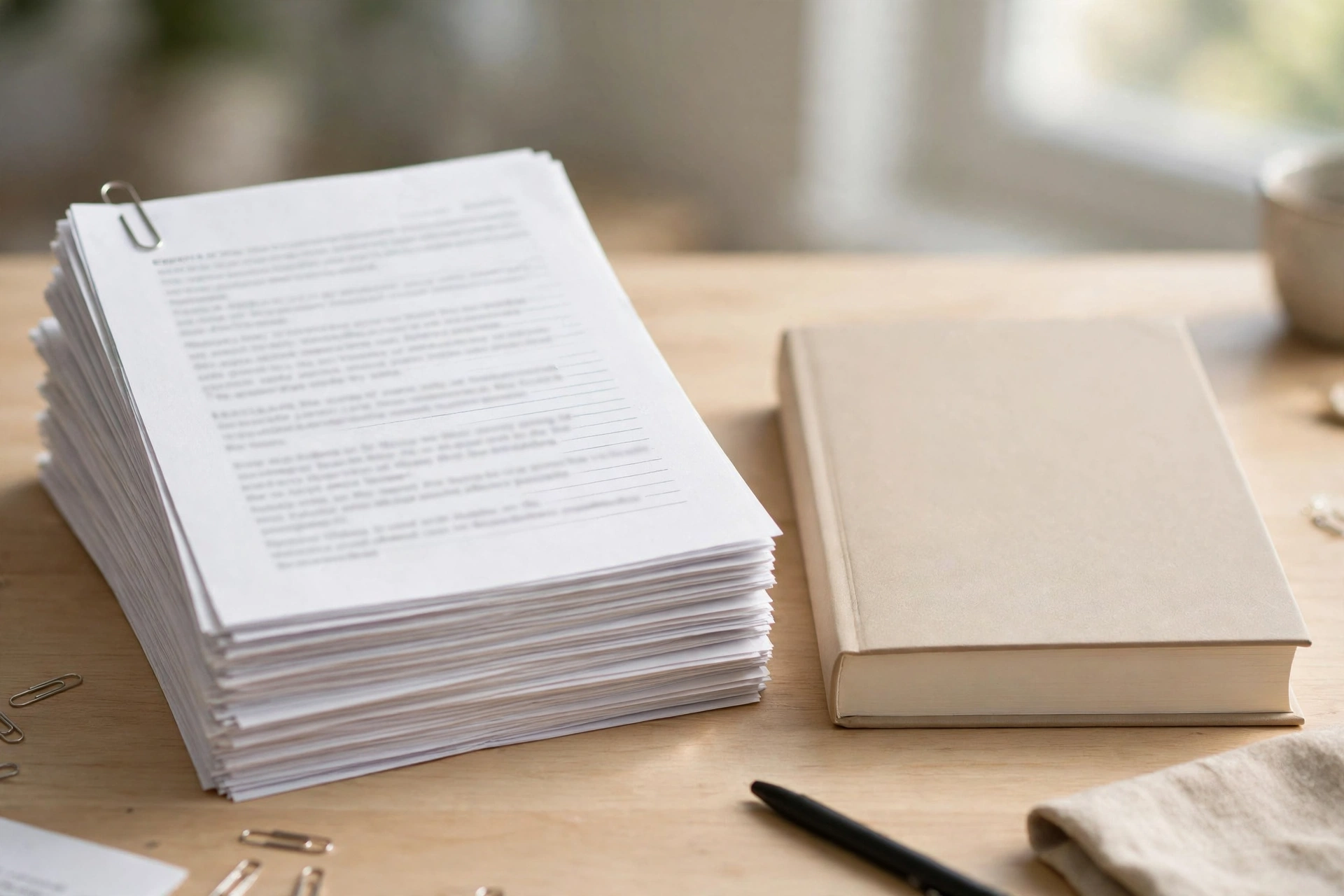
When an agent asks for “the first 50 pages,” they mean 50 manuscript pages (~12,500 words) — not 50 printed pages. And when readers see a “300-page book” on Amazon, that’s the printed count. Always clarify which one you mean.
How to Estimate YOUR Book’s Page Count (4 Steps)

Step 1: Get your exact word count
Paste your full manuscript into a free word counter tool to get your precise total — don’t rely on rough guesses.
Step 2: Pick your words-per-page number
Use 250 for a standard 5″×8″ paperback, 300 for a 6″×9″, or 350 for a tight non-fiction layout. If your book is dialogue-heavy or has short chapters, round down.
Step 3: Divide and add front/back matter
Divide your word count by your words-per-page number, then add 10–20 pages for front matter (title page, copyright, dedication, table of contents) and back matter (about the author, acknowledgments).
Step 4: Sanity-check against your genre
Compare your estimate to the genre table above. If your romance novel is coming out at 500 pages, something’s off — either trim the manuscript or reconsider your formatting assumptions.
Frequently Asked Questions
How many words are on a page in a novel?
A typical novel page holds 250 to 300 words. Fiction on Amazon averages around 280 words per page.
How many pages is 50,000 words in a book?
50,000 words is about 200 pages in a standard paperback (at 250 words per page), or roughly 165 pages in a tighter 6″×9″ layout (at 300 words per page). In manuscript format (double-spaced), it’s 200 pages.
How many pages is 100,000 words?
100,000 words is about 400 pages in a standard paperback — a solid, full-length novel.
Do eBooks have the same words per page?
No — eBooks are reflowable, so “pages” change with the reader’s font size and device. Kindle uses “locations” instead of page numbers for this reason. Word count is the only reliable measure of eBook length.
How many words per page does Stephen King average?
Like most commercial fiction, King’s books average around 250–300 words per printed page. His novels are long because of high total word counts (often 150,000+), not because of unusual formatting.
How many words per page in a children’s book?
Far fewer — picture books rely on illustrations, so a page might hold just 20–50 words. Early readers average 50–100 words per page. Word-count-per-page rules really only apply to text-heavy books for teens and adults.
Why do two books with the same word count have different page counts?
Formatting. A 90,000-word novel can be 320 pages in a 6″×9″ trade paperback with tight typesetting, or 420+ pages in a 5″×8″ with large type and generous margins. Publishers adjust trim size, font, and spacing to hit a target thickness and price point — the words are identical, the packaging isn’t.
Is 200 pages a good length for a book?
It depends on the genre. 200 pages (~50,000 words) is perfect for a novella, memoir, or focused non-fiction book, but short for a mainstream novel — most novels run 300+ pages.
How many words should my first book be?
Aim for 70,000–90,000 words for a debut novel. It’s long enough to feel substantial, short enough to keep printing costs down, and squarely in the range agents expect.
Does font choice really change the page count?
Yes, more than most writers expect. At the same 12pt size, a wide font like Verdana can produce 15–20% fewer words per page than a compact serif like Garamond. When comparing estimates, always assume the same font — or better yet, work from word count, which never changes.
Final Thoughts
So, how many words per page in a book? Plan on 250 to 300 — 250 for your manuscript math, 300 for a finished 6″×9″ paperback. Remember that trim size, font, dialogue, and chapter breaks all move the number, so treat any estimate as a range, not a promise.
The most reliable approach: get your exact word count with a free word counter, divide by 250, add pages for front and back matter — and you’ll know your book’s true length before you ever hit “publish.”