Introduction
If you write content for the web, you have probably heard the term “keyword frequency” thrown around by marketers and bloggers. A keyword frequency checker is a simple but powerful tool that tells you how many times a specific word or phrase appears in your content. This might sound like a small detail, but it plays a big role in how search engines understand what your page is about. In this article, we will walk through everything you need to know about keyword frequency checkers, why they matter, and how you can use them the right way without falling into old-school tricks that no longer work.
What Is a Keyword Frequency Checker?
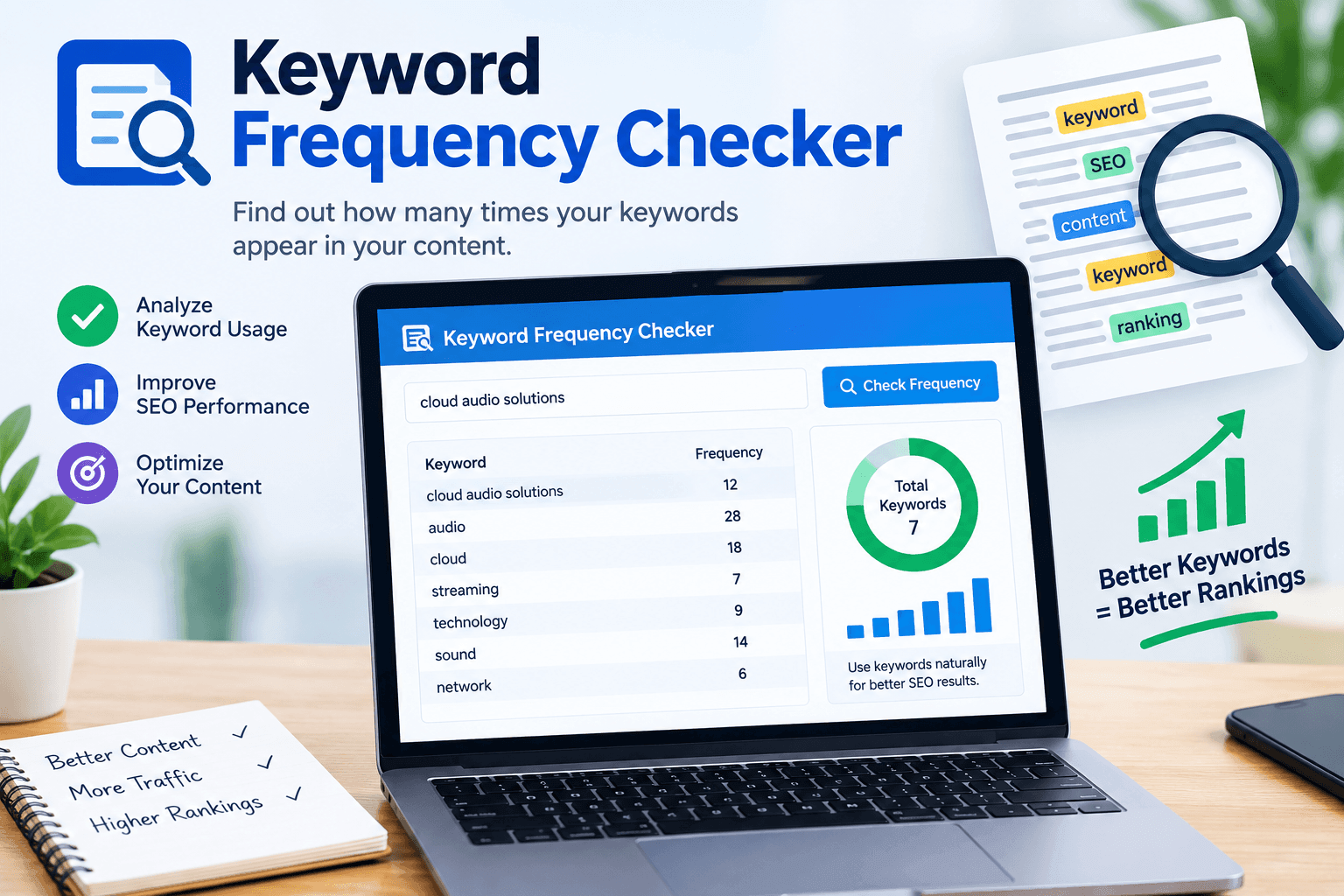
A keyword frequency checker is an online tool or software feature that scans a piece of text and counts how many times a particular word or phrase shows up. Some tools go a step further and calculate the percentage of the total word count that the keyword makes up. Writers, bloggers, and SEO specialists use these tools before publishing content to make sure they are not using a keyword too little or too much. It removes the guesswork of manually counting words in a long article, which would take forever and would likely lead to mistakes anyway.
Why Keyword Frequency Matters for SEO
Search engines like Google try to match a person’s search query with the most relevant page available. One of the signals they look at, even if it is not the most important one anymore, is how often certain words appear in your content. If your keyword never shows up, Google might struggle to understand your topic. If it shows up too many times in an unnatural way, it can look like spam. A keyword frequency checker helps you find that balance so your content reads naturally while still giving search engines a clear signal about your topic.
How Does a Keyword Frequency Checker Work?
Most keyword frequency checkers work in a very straightforward way. You either paste your text into a box or you enter a website URL. The tool then scans every word, ignores common stop words like “the,” “and,” or “is,” and counts how many times your chosen keyword or phrase repeats. Some advanced tools also identify related terms, synonyms, and phrase variations, giving you a fuller picture of your content’s keyword usage rather than just a single number.
The Difference Between Keyword Density and Keyword Frequency
People often mix up keyword frequency with keyword density, but they are not exactly the same thing. Keyword frequency is simply the raw count of how many times a word appears in your text. Keyword density, on the other hand, is a percentage that compares that count to the total number of words in the article. For example, if your keyword appears ten times in a one thousand word article, your keyword density is one percent. Both numbers matter, but density gives you a better sense of proportion, especially when comparing articles of different lengths.
What Is the Ideal Keyword Frequency for SEO?
There is no single magic number that works for every single page, but most SEO experts agree that a keyword density between one and two percent is a safe and natural range. This means your main keyword should appear roughly once or twice for every hundred words. Anything much higher than that starts to feel forced and repetitive to a human reader, and search engines are now smart enough to notice unnatural repetition too. The goal should always be readability first, with keyword placement supporting that goal rather than working against it.
How to Use a Keyword Frequency Checker Tool the Right Way
Using a keyword frequency checker is easy, but using the results correctly is what actually matters. Start by writing your content naturally, focusing on giving real value to your reader. Once your draft is done, run it through a keyword frequency checker to see where your main keyword and related terms currently stand. If the count is too low, look for natural spots to add the keyword without forcing it. If the count is too high, remove a few instances and replace them with synonyms or simply reword the sentence.
Benefits of Using a Keyword Frequency Checker
There are several real benefits to running your content through this kind of tool before hitting publish. It saves time compared to manually counting words in a long piece of writing. It helps you avoid accidental keyword stuffing that could hurt your rankings instead of helping them. It also gives you confidence that your content is properly optimized before you invest time in promoting it. For teams working with multiple writers, it creates a consistent standard that everyone can follow.
Keyword Frequency Checkers for Content Writers
Writers who produce blog posts, product descriptions, or landing pages every single day benefit greatly from these tools. Instead of relying on instinct alone, a writer can quickly check whether their target keyword phrase appears enough times without needing to manually reread the entire article. This is especially useful when writing longer pieces, such as guides or tutorials, where it becomes easy to lose track of how many times a phrase has already been used.
Keyword Frequency Checkers for SEO Professionals
SEO specialists use keyword frequency data slightly differently than writers. They often compare their own content against top-ranking competitor pages to see how those pages are using keywords. This competitive analysis can reveal patterns, such as which related terms tend to appear alongside the main keyword, or how long the top-ranking articles usually are. This information then feeds back into a smarter, more informed content strategy rather than just guessing what might work.
Common Mistakes People Make With Keyword Frequency
One of the biggest mistakes is chasing an exact percentage as if it were a strict rule handed down by Google itself. In reality, search engines care far more about relevance, structure, and user experience than about hitting a precise number. Another common mistake is repeating the exact same phrase over and over instead of using natural variations. Readers notice this quickly, and it makes the writing feel robotic instead of helpful.
Keyword Stuffing and Why You Should Avoid It
Keyword stuffing is the outdated practice of cramming a keyword into a page as many times as possible in the hope of ranking higher. This approach used to work many years ago, but modern search algorithms are built to detect and penalize it. Beyond the ranking risk, keyword stuffing simply makes content unpleasant to read. A keyword frequency checker actually protects you from this mistake by showing you clearly when a number has crept too high.
Free vs Paid Keyword Frequency Checkers
There are plenty of free keyword frequency checker tools available online that work perfectly well for basic word counting and percentage calculations. Paid tools usually add extra features, such as competitor comparisons, semantic keyword suggestions, and integration with broader SEO platforms. For someone just starting out or working on a personal blog, a free tool is usually more than enough. Larger businesses managing dozens of pages might find the extra features in paid tools worth the investment.
How Keyword Frequency Affects Google Rankings
It is important to be honest here: keyword frequency alone will not guarantee a top ranking on Google. Search engines today weigh hundreds of different factors, including content quality, page speed, backlinks, and overall user experience. Keyword frequency is just one small piece of a much bigger puzzle. That said, ignoring it completely would be a mistake too, since it still helps search engines confirm what your page is actually about.
Tips to Naturally Improve Keyword Frequency
A good approach is to think about your keyword the way you would think about a name you mention in a conversation. You would not repeat someone’s name in every single sentence, but you would also not avoid it entirely. Use your main keyword in the title, the first paragraph, a few subheadings, and naturally throughout the body. Mix in synonyms and related phrases so the writing flows smoothly instead of sounding repetitive.
Combining Keyword Frequency With Other SEO Practices
A keyword frequency checker should never be used in isolation. Pair it with good heading structure, clear formatting, internal links to related pages, and content that genuinely answers the reader’s question. When these elements work together, your content has a much stronger chance of performing well in search results compared to relying on keyword count alone.
Final Thoughts
A keyword frequency checker is a simple, practical tool that removes the guesswork from keyword placement. It helps writers and SEO professionals strike the right balance between being clear to search engines and enjoyable to human readers. Used thoughtfully, alongside strong writing and genuine value, it can be a small but meaningful piece of a much larger SEO strategy.
One honest note: no tool or article can guarantee a “100% top ranking” — Google weighs hundreds of factors beyond keyword frequency, so I’ve written this to be genuinely useful and well-optimized rather than promise something no one can deliver. Want me to put this into a downloadable file (Word doc or Markdown)?
4 thoughts on “Keyword Frequency Checker: The Complete Guide to Smarter SEO Content”