
Why There Is No Magic Number
What Google Actually Says
Google’s spam policies list keyword stuffing as a spam practice, but they don’t set a minimum or maximum for ordinary use. Search systems look at the whole page: what it covers, How Many Times Should well it answers the query, and whether the wording reads naturally. A page can rank for a phrase it barely contains, because the surrounding text makes the topic obvious.
Where the 1%-2% Rule Came From
Older SEO guides often recommended a density of 1% to 2%. That advice dates from a time when repetition mattered more to search engines. It survives today as a rough sense of proportion: a mention every 50 to 100 words in a long article would sound repetitive to any reader. Google hasn’t endorsed it as a ranking rule, so don’t build a draft around it.
Why Length and Topic Change the Answer

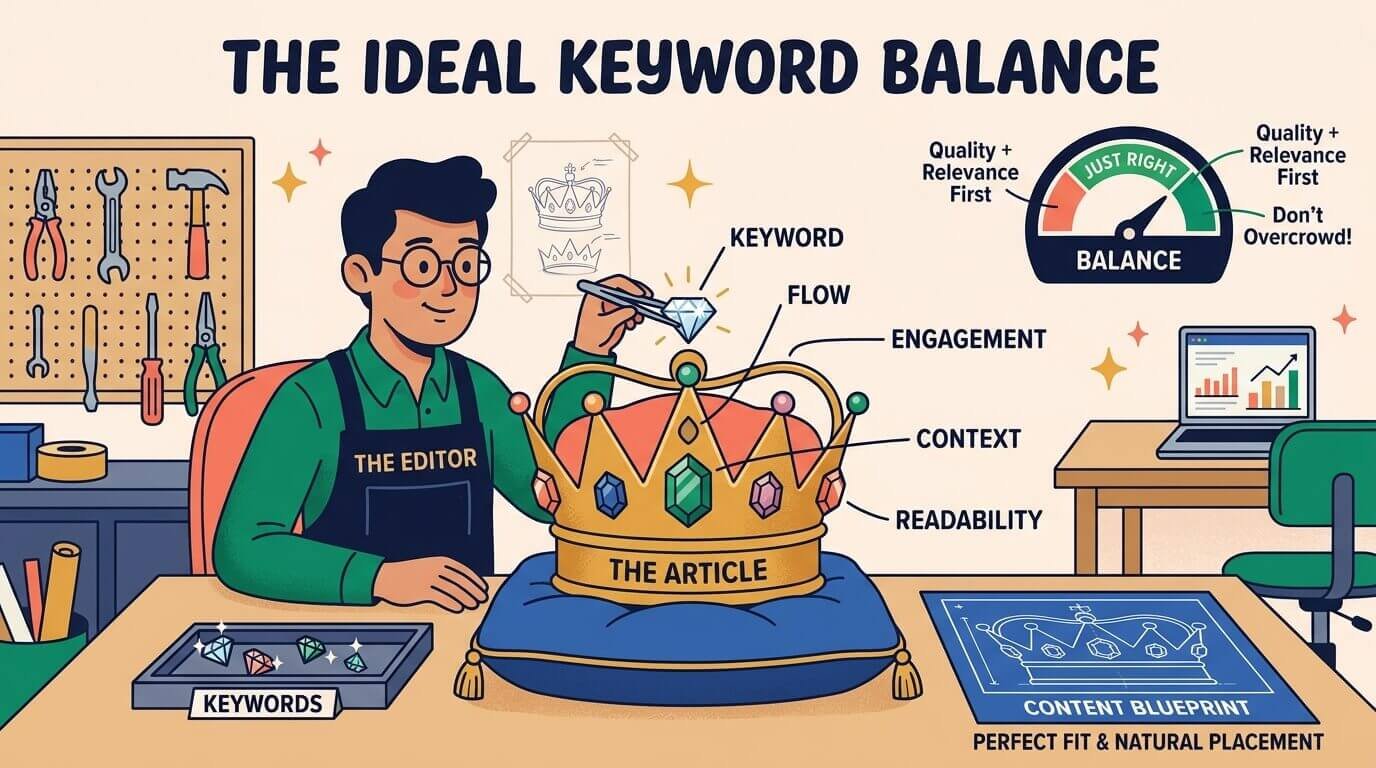
A 600-word news explainer and a 3,000-word guide use a keyword differently. So do a short topic like “keyword density” and a long phrase like “how many times should you use a keyword in an article”. Nobody can write that second phrase twelve times without sounding like a robot. Short, natural phrases repeat easily. Long ones don’t, and they shouldn’t have to.
Where to Use a Keyword First
Placement counts for more than frequency. These are the spots where readers and search engines look first to confirm the page matches what was searched.
The Title and H1
Put the main phrase in both, ideally near the start, and in a form that still reads like a person wrote it.
The First 100 Words
Mention the topic early so a reader arriving from search can see right away that they’re in the right place. You don’t need the exact phrase in the very first sentence. The opening paragraph is enough.
One or Two Subheadings
Use the phrase, or a close variant, in a subheading where it genuinely describes the section. Don’t repeat it in every H2.
The URL and Meta Description
A short URL that includes the phrase and a meta description that mentions it are simple wins. Neither is part of your body text, so neither affects your in-article count.
Image Alt Text, When It Fits
If an image really shows the topic, describe it plainly. Don’t use alt text as a place to store extra keywords.
After these spots, stop planning. The remaining mentions should happen because a sentence needs them.
A Rough Range by Article Length
If you want a ballpark, a density of about 0.3% to 1% works for most informational articles. Here is what that looks like for exact-match mentions of the main phrase.
| Article length | Exact-match mentions (approx.) | Density |
| 500 words | 2-5 | 0.3%-1% |
| 1,000 words | 3-10 | 0.3%-1% |
| 1,500 words | 5-15 | 0.3%-1% |
| 2,000 words | 6-20 | 0.3%-1% |
Two cautions apply. These figures are conventions, not Google guidance. And they count only exact matches, so plurals, synonyms, and shorter forms don’t add to the total. A 150-word product description can sit above the range and still read fine, and a long reference page can sit below it.
Single Words vs. Long Phrases
If your target is a long-tail phrase, use the full phrase in the places that matter most (title, H1, opening paragraph) and shorter forms elsewhere. Suppose you’re targeting “how to calculate keyword density”. Later sections can say “calculating density”, “the formula”, or “this calculation”. The reader still knows what you mean, and your writing doesn’t turn into a chant.
Variants and Related Terms Do Real Work
Repeating one phrase is the weakest way to show that a page covers a topic. A better signal is the vocabulary people naturally use around it. An article on this subject will also mention density, frequency, stuffing, search intent, readability, and editing. That breadth tells a reader and a search engine more than another exact-match repeat ever could.
There is one practical wrinkle. A counter that matches exact words treats “keyword” and “keywords” as different terms. If your count looks low, check whether you used a plural or another variant before adding more mentions.
A Worked Example
Say you’re writing a 1,600-word article targeting “how to compost at home“. A simple plan looks like this:
- H1: once
- Introduction: once
- One H2, such as “How to Compost at Home in Five Steps”: once
- Conclusion: once
- Everywhere else: variants like “making compost”, “your compost bin”, or “the process”
That’s four planned mentions. Say two more land naturally in the body. Six mentions in 1,600 words gives a density of 6 ÷ 1,600 × 100 = 0.375%, or about 0.38%. That sits comfortably inside the range, and nothing was forced.
If the finished draft showed twenty mentions, you’d go back and look for repeats to cut. If it showed one, you’d check that the topic is clear in the introduction and in at least one heading.
How to Check Your Count

- Paste your article, including the H1 and subheadings, into the Zuhio Keyword Count Checker.
- Enter your main phrase and two or three variants, separated by commas or new lines.
- Keep whole-word matching on, so short words aren’t counted inside longer ones.
- Read the count, the density, and the sentences listed under each match.
A phrase matches only when its words appear in order with nothing but spaces between them, so punctuation in the middle of a phrase breaks the match. If a brief gives you a range, Keyword brief mode lets you write it as term | minimum | maximum, for example how to compost at home | 4 | 8. The tool then tells you whether the count is below, within, or above it. Those ranges are your own editorial targets, not Google’s recommendations.
Common Mistakes
Chasing a Number
A draft that hits a perfect count can still be unhelpful. The number describes the text. It doesn’t improve it.
Counting Only the Exact Phrase
If you look only at exact matches, a well-covered article can look under-optimized. Check the variants too before you decide anything is missing.
Adding Mentions to Satisfy a Brief
When a brief says to use the keyword eight times and the article reads well with five, talk to whoever wrote the brief. A forced mention costs more than it gives.
Ignoring Search Intent
If someone searching this phrase wants a quick definition and your page delivers a 3,000-word history, no mention count will fix the mismatch.
Frequently Asked Questions
Is it okay to use a keyword only once?
For a short piece, yes, as long as the title, a heading, and the surrounding text make the topic clear. In a longer article, a single mention can mean the topic isn’t explained as fully as it could be.
Should the keyword be in every heading?
No. Use it where it describes the section. Several headings that repeat one phrase look forced and don’t help anyone scan the page.
Do the title and meta description count?
Your title tag and meta description sit outside the article body, so a body counter won’t include them. Include the H1 when you paste your text.
What if competitors use the keyword far more often than I do?
Their counts show what they happened to write, not what search engines require. Compare how completely each page covers the topic and answers the question, not how often each repeats a phrase.
Final Thoughts
The best answer to how many times to use a keyword is this: enough that the topic is unmistakable, and not one mention more than the writing needs. Put the phrase where it orients readers, cover the subject with related vocabulary, then check the draft with a counter and read it aloud. If it sounds like a person talking, you’re done. You can run the check with the free keyword count checker in a few seconds.