
Introduction
You have picked your target keyword. Now the temptation kicks in: use it everywhere — in every heading, every paragraph, every image caption. After all, more keywords must mean better rankings, right?
Wrong. That practice has a name — keyword stuffing — and Google lists it explicitly as a spam policy violation. Pages caught Avoid Keyword Stuffing can drop in rankings or be removed from search results entirely.
The good news: avoiding keyword stuffing is simple once you know the rules. This guide shows you exactly what stuffing looks like, why it hurts, and 7 safe practices that keep your content optimized without crossing the line.
What Is Keyword Stuffing?

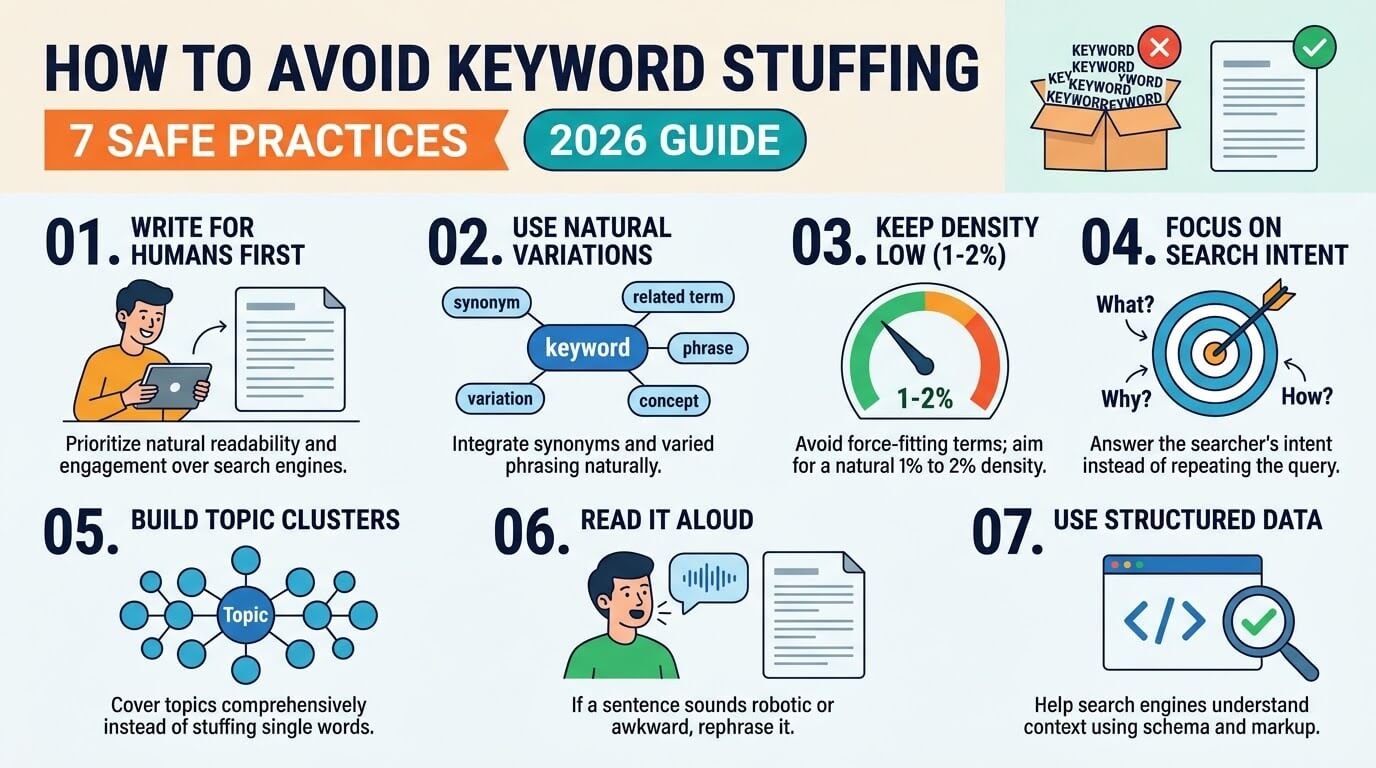
Keyword stuffing means loading a webpage with keywords unnaturally to manipulate rankings. Google’s spam policies describe it as filling pages with keywords or numbers without adding real value for the reader.
It comes in two forms:
- Visible stuffing: repeating the same phrase over and over in your text. Example: “Our cheap SEO services are the best cheap SEO services. If you need cheap SEO services, our cheap SEO services company offers cheap SEO services.” Painful to read, right?
- Hidden stuffing: blocks of keywords in footers, lists of city names (“SEO London, SEO Manchester, SEO Birmingham…”), or text colored to match the background. Search engines detect all of these.
If a sentence sounds awkward with the keyword forced in, that is stuffing. One natural mention beats five forced ones.
Why Keyword Stuffing Hurts Your Rankings in 2026
Stuffing is not just outdated — it is actively punished:
- It violates Google’s spam policies. Keyword stuffing is named directly in Google’s official spam documentation, alongside cloaking and sneaky redirects.
- Rankings can collapse. When algorithms detect manipulation, pages can lose positions dramatically or be excluded from results.
- Readers bounce. Stuffed content reads terribly. Visitors leave fast, and poor engagement signals make rankings worse.
- Density does not equal rankings. Modern research shows no correlation between keyword density and ranking position. Chasing a magic percentage is a waste of effort.
Google’s algorithms have understood context and synonyms since the Hummingbird update. They reward pages that cover a topic well — not pages that repeat one phrase the most.
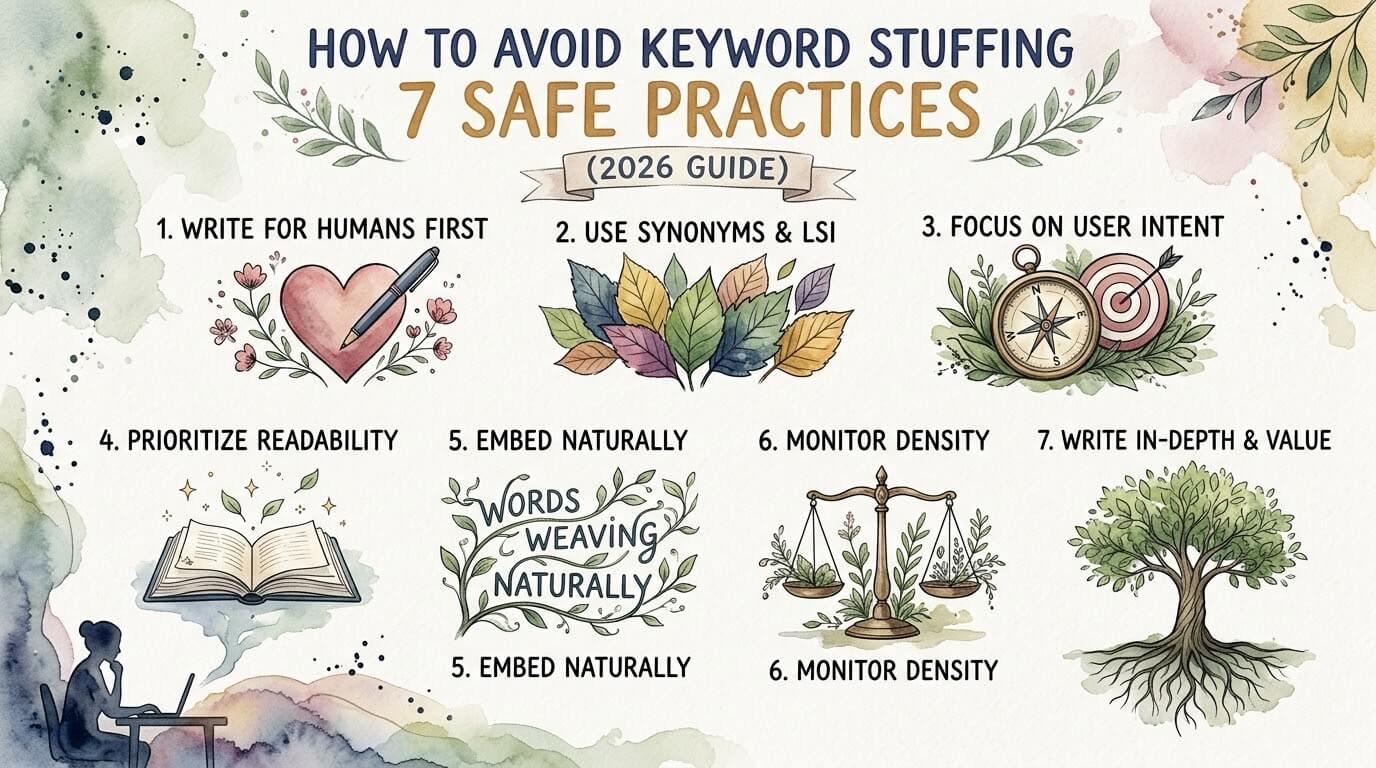
7 Safe Practices to Avoid Keyword Stuffing
1. Write for readers first, search engines second
Before writing, ask: what is the searcher really trying to do? Answer their question as clearly as you can, in a natural conversational tone — as if explaining it to a friend. If the content genuinely helps people, the keywords take care of themselves.
2. Give every page one clear primary keyword
Each page should target exactly one main keyword. When a page tries to rank for five phrases at once, writers cram them all in — and that is how stuffing starts. One page, one topic, one primary keyword. Related pages can target related keywords and link to each other.
3. Place keywords strategically, not excessively
Your keyword still matters — as a signpost, not a decoration. Put it in the few spots that carry the most weight, then stop:
| Location | How many times |
|---|---|
| Title tag | Once, near the start |
| H1 heading | Once |
| URL slug | Once |
| Meta description | Once, in a natural sentence |
| First 100 words | Once |
| One H2 subheading | Once |
| Image alt text | Only where it describes the image |
| Body text | Naturally, a few times |
For a deeper walkthrough of this approach, see our guide on keyword density SEO.
4. Use synonyms and keyword variations
Instead of repeating “cheap SEO services” ten times, mix in “affordable SEO help,” “budget search optimization,” or “low-cost SEO.” Google understands semantic relationships between words, so variations strengthen your topic coverage without repetition. This is the single easiest way to kill stuffing while staying optimized.
5. Keep density natural — check, do not chase
There is no official density number from Google, but these ranges are widely considered safe:
| Density | Verdict |
|---|---|
| Below 0.5% | Possibly too low — topic may be unclear |
| 0.5% – 1% | Ideal for most pages |
| 1% – 2% | Fine if it reads naturally |
| Above 3% | Stuffing risk — rewrite |
Use density as a check, not a target. Run your draft through a free word density checker — if any term dominates, rewrite with variations. Learn the full method in our keyword frequency counter guide.
6. Write first, optimize second
The most practical workflow: draft the whole page around the reader’s needs with zero thought about keywords. Then do one review pass — add the keyword to the title, H1, intro, and one subheading where it fits naturally. Separating writing from optimizing prevents the “squeeze it in everywhere” instinct.
7. Cover related questions instead of repeating phrases
Rather than saying your keyword fifteen times, answer the questions people actually ask about the topic. A page about keyword stuffing that covers “what is keyword stuffing,” “Google’s penalty,” and “safe density” naturally includes rich, varied language. For background on the core concept, read what is keyword density.
Keyword Stuffing Examples: Bad vs Good
| Stuffed (bad) | Natural (good) |
|---|---|
| “Buy cheap running shoes. Our cheap running shoes are the cheapest cheap running shoes online.” | “Looking for affordable running shoes? Our guide compares the best budget options for 2026.” |
| “Plumber Austin, plumber Austin TX, best plumber Austin, cheap plumber Austin” | “Our licensed plumbers serve the Austin area with same-day repairs.” |
| Keyword in every H2: “Cheap Shoes,” “More Cheap Shoes,” “Cheap Shoes FAQ” | Varied headings: “Top Budget Picks,” “How to Choose,” “Sizing Guide” |
FAQs
What is the safe keyword density to avoid stuffing?
Google publishes no official number. A density of 0.5%–1% is ideal for most pages, and up to 2% is fine if the text reads naturally. Above 3%, you are in stuffing territory. Use density as a sanity check, not a target — see our good keyword density guide for details.
Can keyword stuffing get my site penalized?
Yes. Keyword stuffing is listed in Google’s spam policies. Detected pages can suffer ranking drops or removal from search results. The risk is real and the reward is zero — stuffed pages do not outrank well-written ones.
How many times should I use my keyword in a 1000-word article?
Around 5–15 natural mentions (roughly 0.5%–1.5%) is plenty. Focus on strategic spots — title, H1, intro, one subheading — and let synonyms handle the rest.
Is repeating a keyword in every heading stuffing?
Almost always, yes. Forcing the exact phrase into every H2 is a classic stuffing pattern. Use it in one subheading at most, and write the rest naturally.
Do synonyms count as keyword stuffing?
No — the opposite. Using synonyms and related terms is exactly what Google wants. It shows genuine topic coverage instead of mechanical repetition.
Conclusion
Avoiding keyword stuffing comes down to one mindset shift: write for people, then check for search engines. Pick one keyword per page, place it in the high-impact spots, vary your language, and verify with a density check before publishing.
Want to check your draft right now? Paste it into our free Word Density Checker — it shows every keyword’s frequency and warns you before stuffing becomes a problem. No signup needed.