Keyword Frequency Counter: A Simple Guide to Finding Your Most Used Words
Every writer has favorite words they use again and again without noticing. You may repeat the same adjective in every paragraph, or forget your main topic word in a long post. Spotting these patterns by eye is hard. A keyword frequency counter does it for you in seconds. It lists the words and phrases in your text and shows how many times each one appears. In this guide, you will learn how it works, how to read the results, and how to use it for better writing, all in plain words.
What Is a Keyword Frequency Counter?
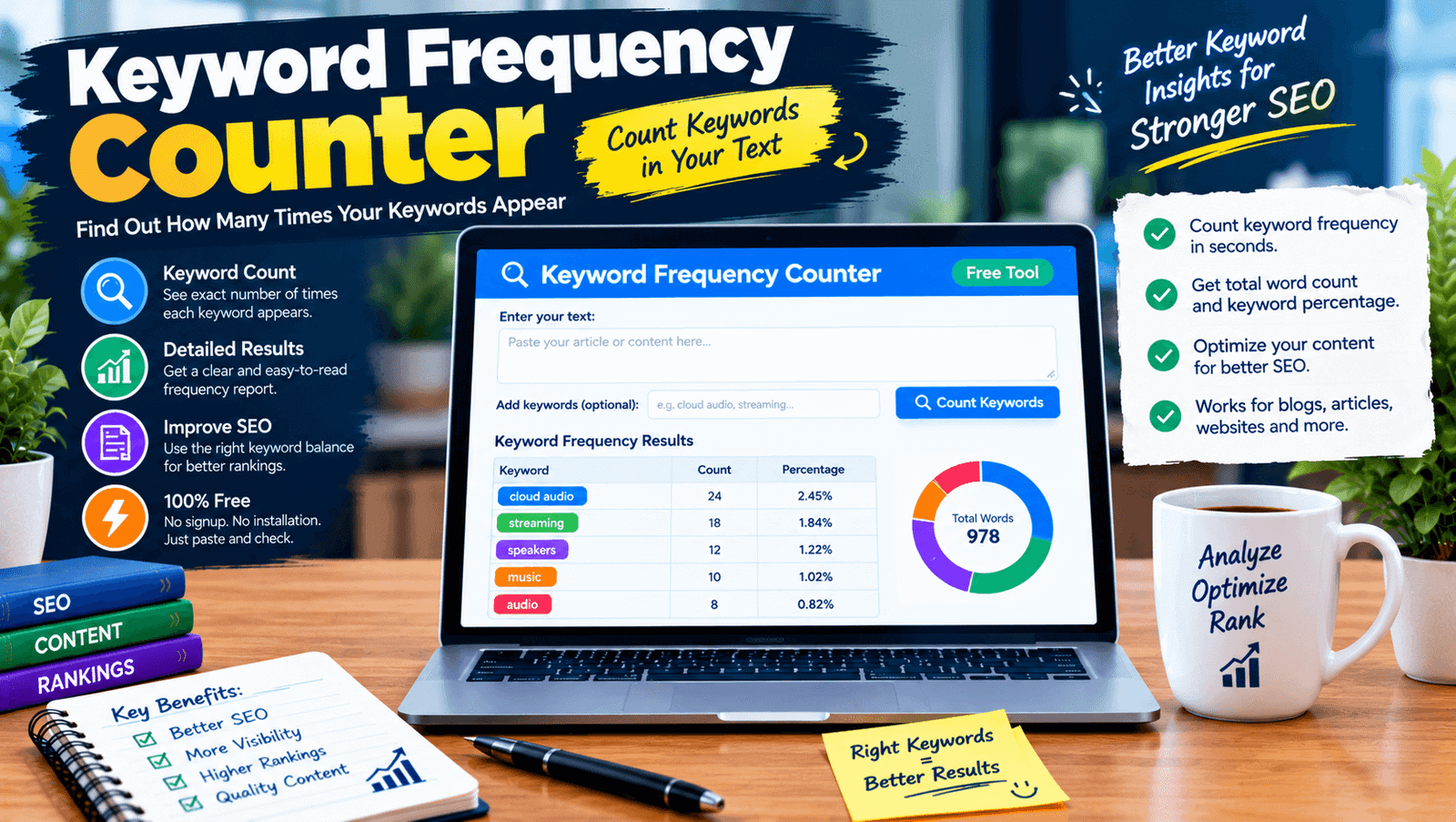
A keyword frequency counter is a tool that counts how many times a word or phrase appears in a piece of text. You paste your content, and the tool shows a list or a table with each word and its count. Some tools let you type your own keywords, while others build a list of the most used words by themselves. The result is a simple picture of what your text talks about most, and which words may be showing up too often.
How a Keyword Frequency Counter Works
The tool first breaks your text into words, usually by spaces and punctuation. It then counts every word and groups the same ones together. A good keyword frequency counter can also group two or three words as a phrase and count those too. Many tools ignore case, so “Audio” and “audio” count as one word, while some offer a switch for exact case. Most also remove common filler words if you ask. The whole process takes seconds, even for a long article.
Keyword Frequency vs Keyword Density
These terms are close, but they are not the same. Keyword frequency is the raw count: how many times a word appears. Keyword density turns that count into a percentage of the total words. For example, 15 mentions in a 1,500-word article is a density of 1 percent. Frequency is easier to understand and does not change when you add unrelated text. Density helps you compare texts of different lengths. Many editors look at both, but start with frequency because it is simple.
Why Writers and Editors Need a Keyword Frequency Counter
We all repeat ourselves without noticing. A frequency list shows this at once. If one word appears twenty times and sounds dull, you can swap some of them for synonyms. If your main topic word appears only once, you may have drifted off topic. Editors use counts to give fair feedback to many writers using the same rules. Website owners use them to review old posts. A quick check saves hours of rereading and makes your writing cleaner.
Finding Your Most Used Words
One of the best uses of a frequency tool is finding your habits. Run your text and look at the top of the list. Ignore small words like “the” and “and,” and focus on the meaningful ones. You may find a favorite verb or a filler word like “really” or “very” appearing too much. A keyword frequency counter makes these habits visible. Once you see them, you can vary your language, and the writing feels fresher and more careful.
Single Words and Phrases
Single words show your general vocabulary. Phrases show your real topics. A two-word or three-word phrase, such as “wifi speakers” or “cloud audio streaming,” often tells you more about your page than any single word does. Many tools let you count phrases of different lengths. Check both. If an important phrase is missing or appears too rarely, your page may not be clear on its topic. If a phrase appears in almost every sentence, the writing may feel heavy and repetitive.
What Are Stop Words and Should You Count Them?
Stop words are very common words like “the,” “is,” “of,” and “and.” They appear so often that they fill the top of any frequency list and hide the useful words. Most tools can hide them with one click. For topic checks, hide stop words. For checking sentence style or grammar habits, keep them. Some tools let you add your own stop words, which helps when your text has repeated words that are not useful, such as a brand name in a footer.
Features of a Good Keyword Frequency Counter
Look for a clear table that sorts words by count. Phrase counting is very helpful. A stop word filter saves time. The option to ignore or match case gives control. Showing total words helps you understand the numbers. A search box for your own keywords is useful. Copy or export options help you move results into a spreadsheet. Fast results on long text matter too. And a simple design with no signup makes the tool easy to use again and again.
How to Use a Keyword Frequency Counter Step by Step
First, finish your draft or collect the text you want to check. Second, paste it into the tool. Third, choose your settings, such as ignoring case and hiding stop words. Fourth, run the count. Fifth, read the list from the top and look at your main keyword. Sixth, edit the text where a word appears too often or not enough. Last, run it again to check the changes. This simple process with a keyword frequency counter usually takes only a few minutes.
How to Read a Frequency Table
Start from the top. The most frequent meaningful words should match your topic. If they do not, your text may be off focus. Next, look for words that appear far more than others and read their sentences. Then check your main keyword and its close variations. Do not worry if a word appears many times in a long text, since length changes what is normal. A keyword frequency counter gives the numbers, but you give the meaning. The goal is a clear match between your words and your message.
Using a Keyword Frequency Counter for SEO Content
For web content, a frequency count helps you confirm that your main keyword and related words appear naturally. Check that your main keyword is in the text and in the headings. Look at related words to see if you covered the topic well. Compare your page with top pages by running their text through the same tool, and note subtopics they cover. Do not copy their numbers, because the goal is to be useful, not identical. A keyword frequency counter is a helper, not a ranking trick.
Using It for Essays and Study
Students can use frequency counts to see if an essay stays on topic and to find overused words. If your key term appears rarely in an essay about that topic, you may need to add focus. If one word appears too often, try synonyms or rewrite the sentence. Teachers also use word counts to look at vocabulary. It is a gentle way to improve style, without changing your own ideas or voice.
Cleaning Your Text Before You Count
Dirty text gives dirty results. Remove menus, page numbers, footers, and repeated headers before you paste. Check for odd symbols or code from copying a web page. Make sure you paste only the text you want to measure. If your document has quotes you did not write, decide whether to include them. Clean input makes a keyword frequency counter much more accurate, and it saves you from chasing numbers that came from the page layout instead of your writing.
Common Mistakes to Avoid
One mistake is counting stop words and thinking the list is useful. Another is checking only the main keyword and ignoring phrases. Some people forget that plurals count as different words, so “speaker” and “speakers” are separate. Others copy numbers from a different site and change their text to match. A few paste text with extra code. Using a keyword frequency counter well means reading the results with care, not chasing a perfect list.
Free vs Paid Tools
Free tools are enough for most people. They count words, show tables, and filter stop words. Paid tools add research data like search volume and competition, which are different tasks. If your goal is to review your own writing, a free tool does the job. If you need keyword ideas, add a research tool. Pay only for features you will really use, and check how a tool treats your text before pasting private work into it.
What a Keyword Frequency Counter Cannot Tell You
A frequency count shows what is in your text, not how well it will perform. It cannot predict rankings, show search volume, or judge if your writing is clear and correct. It treats word forms as separate and does not understand meaning, so synonyms are not grouped. Context matters too, since a word used five times in five useful ways is different from the same word repeated five times without purpose. Use the numbers as clues and always read the text yourself.
Final Thoughts on the Keyword Frequency Counter
A keyword frequency counter is a simple, friendly tool that shows what your words are really doing. Use it after writing, clean your text first, hide stop words, and read the top of the list. Edit slowly and keep your own voice. With a few minutes of checking, you can remove repeated habits, stay on topic, and write pages that feel clear and natural to your readers.