How to Avoid Keyword Stuffing: Why It Matters
Every writer who learns SEO meets the same temptation: if one keyword is good, ten must be better. It feels logical, but it leads to pages that sound robotic and tire the reader. Learning how to avoid keyword stuffing protects your work from this trap and keeps your writing friendly. A page that is full of repeats may lose trust with both readers and search engines, and it often performs worse than a calm, clear page. The good news is that the fix is not hard. When you know how to avoid keyword stuffing, you can use your target phrase wisely, write more freely, and spend your time on ideas that really help the person reading.
What Keyword Stuffing Looks Like
Stuffing happens when a word or phrase is repeated so often that the text sounds unnatural. A page may repeat the same phrase in every sentence, add long lists of similar words at the bottom, or squeeze the phrase into titles, headings, and links until they all look alike. Some people even hide words in tiny or background-colored text. A quick way to notice it is to read a paragraph and ask whether a normal person would talk that way. If the answer is no, the page is probably leaning toward stuffing. Recognizing the signs is the first step, because you cannot fix a problem that you do not see.
Why Stuffing Hurts Your Pages
Stuffed pages are unpleasant to read, and unhappy readers leave quickly. Search engines also treat unnatural repetition as spam in their guidelines, so a stuffed page may lose ground or be ignored. Even if nothing bad happens at once, the page gives weak value, because the space used by repeats could have been used for answers, examples, and details. Stuffing also makes a brand look careless, as if it cares more about machines than people. Over time, a site full of such pages struggles to earn trust, links, and shares. Clear and helpful writing always has a better long-term result, and it is also much more enjoyable to produce.
How to Avoid Keyword Stuffing Before You Write
The best protection starts before the first sentence. Decide what the page must teach, and write that goal in one plain line. Choose one main keyword and a few related phrases, but do not set a high number of repeats as a target. Look at the questions the reader is likely to have, and plan headings that answer them. This is how to avoid keyword stuffing before you write: you plan a useful structure first and let the keyword fit inside it. A page built on real questions naturally includes the right words, and you will not feel pressure to force them in.
Start With the Reader, Not the Keyword
Imagine a real person who types your phrase into a search box. What problem do they have, and what answer would make them feel helped? Write for that person, in the same simple words they use. When your goal is to help, the keyword appears where it should, in the title, the first paragraph, and a few headings. When your goal is to hit a number, the text begins to feel forced. Keeping the reader in your mind is the best habit for how to avoid keyword stuffing, and it also improves every other part of your writing, from tone to examples to the order of ideas.
How to Avoid Keyword Stuffing While Writing
During the writing stage, focus on flow. Write your first draft almost without thinking about the keyword, and then check where it already fits. If a sentence works better with a simple pronoun, such as “it” or “this,” use that instead of the full phrase. If a paragraph does not need the keyword at all, leave it out. This is a practical rule for how to avoid keyword stuffing: let the phrase appear because the sentence needs it, never because a counter wants it. You can always add one more use later, but removing awkward repeats from a finished draft takes more effort and care.
Use Variations and Related Phrases
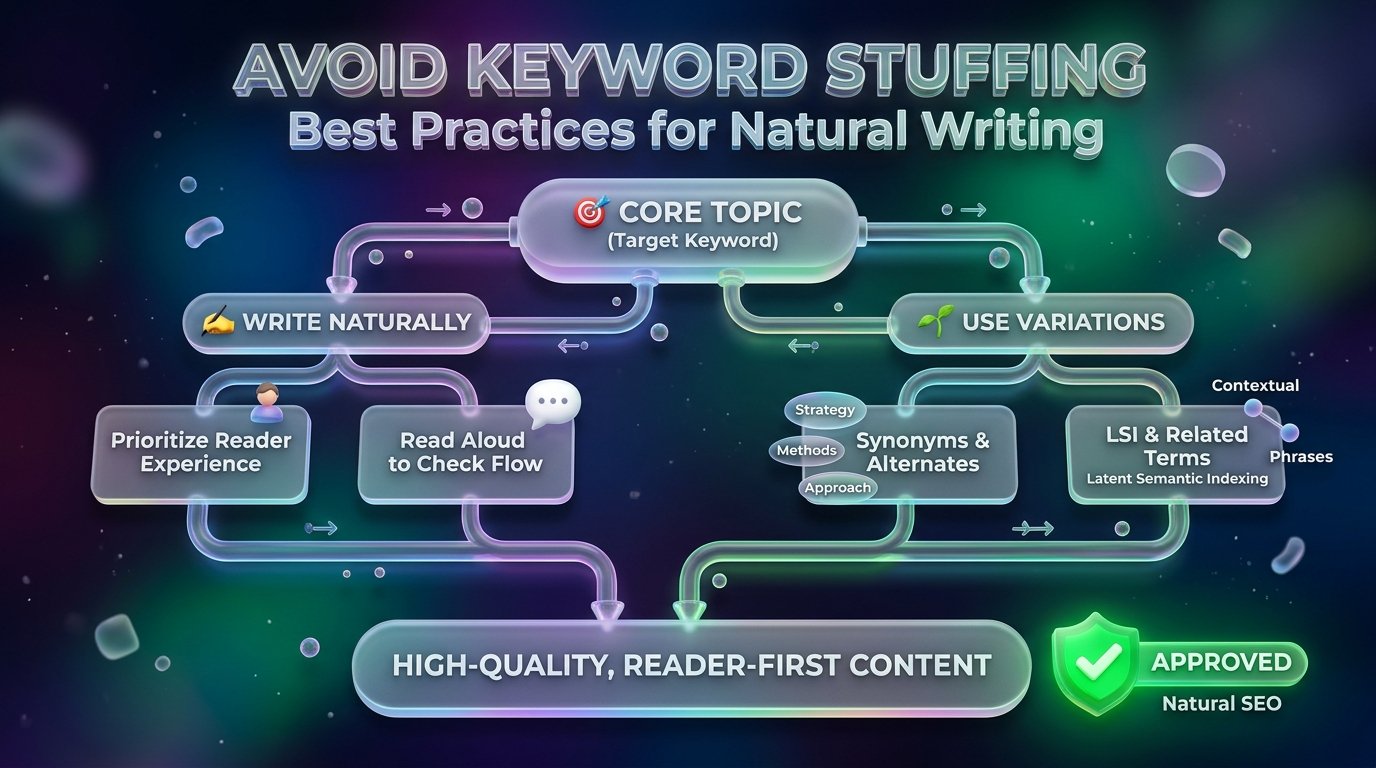
People do not always use one fixed phrase, and search engines know it. Use close variations, short forms, and related words. If your main keyword is “audio converter,” you can also write “tool for changing audio files,” “convert sound,” or “audio format changer” where they sound natural. Add the questions people ask, the common problems, and the steps to solve them. This makes your text richer and easier to read. It also covers many searches with one page, which is better than repeating one phrase again and again. Variety is the opposite of stuffing, and it gives your writing a more human voice.
Use Pronouns and Natural Sentences
A simple trick is to rely on normal language. After you name a topic once, you can refer to it as “it,” “this method,” “the tool,” or “the process.” Real speakers do this all the time, and it keeps sentences smooth. Break long sentences into shorter ones, and vary their length. A paragraph where every sentence starts and ends with the same phrase feels like a chant. Natural sentences have rhythm and change as they go. When you write the way you would explain the subject to a friend, the keyword will appear in a healthy number without any extra effort or special tricks.
How to Avoid Keyword Stuffing in Titles and Headings
Titles and headings are common places for stuffing because they are short and visible. A title like “Best Shoes | Cheap Shoes | Buy Shoes Online” repeats itself and reads like a list. Use the main keyword once in the title, and write it as a clear phrase that tells a human what they will get. In headings, do not force the phrase into every line. Use it in one or two where it fits, and write other headings with related words or plain questions. When thinking about how to avoid keyword stuffing in titles and headings, remember that variety helps both the eye and the meaning.
Keep Web Addresses and Meta Tags Clean
Short and clear web addresses are easier to read and share. Use the main idea once, and remove extra words that only repeat it. For the meta description, write one or two friendly sentences that explain what the page offers. Do not paste a row of phrases. The same rule applies to image descriptions, called alt text, which should describe the picture for people who cannot see it. A good alt text says what is in the image in simple words, and it does not need the keyword every time. Clean small details show care, and they keep your whole page free from the feeling of forced repetition.
How to Avoid Keyword Stuffing in Product Pages
Shops often repeat the product name in every line, or copy the same text across many pages. Instead, fill each page with facts that buyers care about: size, material, color, price, shipping, care, and returns. Write a short, honest description that changes from product to product. Use the product name naturally a few times, and use specific words for details. Do not add lists of cities or random related phrases that have no link to the item. Knowing how to avoid keyword stuffing in product pages helps customers feel safe, and clear details help them decide faster, which is better for sales than any repeated phrase.
Check Your Count With a Keyword Tool
Numbers can warn you before readers do. Paste your text into a free keyword counter, and look at how often your main phrase and its parts appear. If one phrase is far ahead of all other meaningful words, review those spots. Check also two-word and three-word phrases, because stuffing often hides there. No tool can give a perfect safe number, and search engines do not publish one, so use the result only as a guide. A common range for a long article is a small share of the total words, but the real test is how the text sounds when you read it with fresh eyes.
How to Avoid Keyword Stuffing When Editing

Editing is where most problems get solved. Take a short break after writing, then reread the page slowly. Highlight every use of the keyword and look at the spread. If several uses sit close together, remove or rewrite some. Replace repeated phrases with a pronoun or a related term. Cut sentences that only repeat an earlier idea. Add an example, a short story, or a clear step where the text feels thin. This calm review is an important part of how to avoid keyword stuffing, since a fresh look helps you notice habits that you missed when writing quickly.
Read Your Page Out Loud
Your voice is a simple and powerful tool. When you read a page out loud, repeated phrases stand out because they sound strange in speech. If you stumble or smile at a line because it sounds silly, fix it. You can also ask a friend to read the text and tell you where it feels odd. Fresh ears often notice what the writer cannot. This step costs nothing and takes only a few minutes, but it catches many problems that tools cannot find. If the text sounds like a real person giving real help, you are on the right path.
Common Mistakes to Skip
The first mistake is chasing a fixed percentage and forcing text to match it. The second is copying old advice that says more repeats always help. The third is using the same keyword on many pages of one site, which makes pages compete. The fourth is stuffing alt text, menus, and footers. The fifth is rewriting a page by only swapping words without adding value. A sixth mistake is ignoring old pages that were written long ago. Skipping these mistakes is a big part of how to avoid keyword stuffing, and it is easier when you keep a simple checklist beside you while you work.
Frequently Asked Questions About How to Avoid Keyword Stuffing
People often ask what number of repeats is safe. There is no official figure, so follow the sound of the text. Others ask if synonyms are enough. They help, but the page must also be useful. Some ask if old pages need cleaning. Yes, review the important ones first. Many ask if a counter tool can prove a page is safe. It can only guide you. A clear plan for how to avoid keyword stuffing answers most worries. When doubts return, go back to how to avoid keyword stuffing in the steps above, and test your page by reading it out loud one more time.