
What Is Keyword Stuffing With Examples?
Keyword stuffing means filling a page with the same word or phrase again and again, only to try to rank higher in search results. It is the habit of putting the keyword in every sentence, even when it makes the text sound strange. People who do it hope that more repeats will send a stronger signal to search engines, but the result is a page that is tiring to read and often seen as spam. When people ask what is keyword stuffing with examples, they usually want to see real lines that show the problem. This guide gives simple examples of bad writing, explains why they fail, and shows better ways to write the same idea.
Why People Stuff Keywords
Most people who stuff keywords are not bad people. They are beginners who read an old tip saying that more repeats mean better rankings, and they try to follow it with great effort. Some are also afraid that the page will not be understood unless the keyword appears everywhere. Others use poor tools that give strict targets, and they push the text until the numbers look right. In the early days of the internet, these tricks worked for a while, which is why the habit never completely died. Today search systems are much smarter, and the same trick usually harms the page instead of helping it.
Understanding What Is Keyword Stuffing With Examples in Plain Words
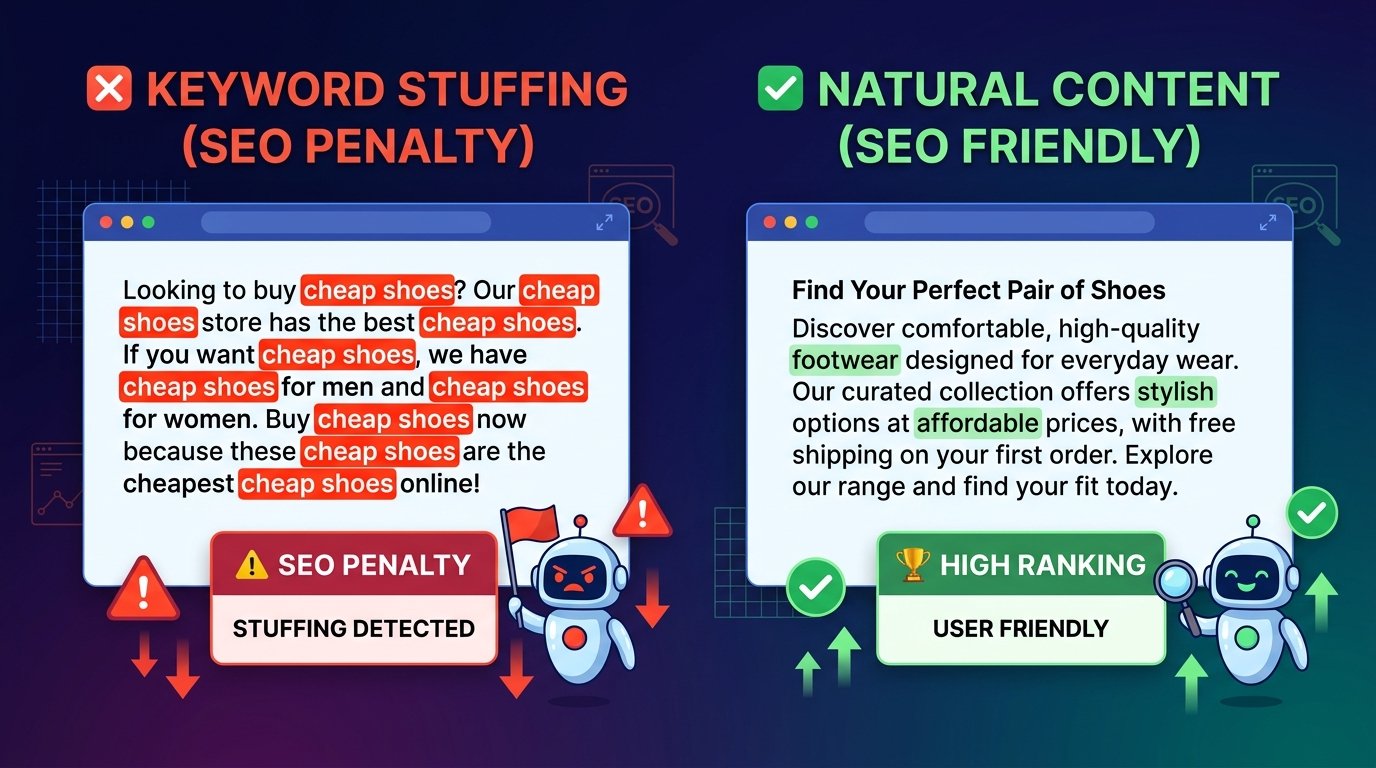
To understand what is keyword stuffing with examples, think of talking to a friend. If you ask someone for good shoes and they answer, “Our cheap running shoes are the best cheap running shoes, so buy cheap running shoes today,” you would feel something is wrong. The phrase repeats too much and does not help you. That is the core idea. A simple test is this: if a sentence sounds odd when read out loud, or if the keyword appears where a normal person would use a different word, it may be stuffing. Real writing varies its words and keeps the reader’s needs in mind.
Bad Example One: Repeating the Same Phrase
Here is a clear case. “We sell cheap running shoes. Our cheap running shoes are made from strong material. If you want cheap running shoes, visit our cheap running shoes store.” In four short lines, the same phrase appears four times, and the reader learns almost nothing new. There is no detail about size, comfort, or price. The text exists for the machine, not for the person. This is the most common form of stuffing, and it is easy to spot. A better version might say, “We sell light, low-cost running shoes in many sizes, and each pair has a soft sole for daily jogging.” It still serves the topic, but it reads like a person wrote it.
Bad Example Two: Hidden or Unnatural Text

Some people go further and hide keywords from readers. They may write a long list of phrases in the same color as the page background, make the text very tiny, or tuck it behind an image so only crawlers see it. Others add a block of words at the bottom of a page, like “running shoes, cheap shoes, best shoes, buy shoes online, shoes sale,” over and over. These tricks are clear signs of spam, and search engines list them as violations of their rules. The risk is high and the reward is low. If a page needs hidden text to rank, it does not have real value, and the best fix is to improve the visible content.
What Is Keyword Stuffing With Examples in Titles and URLs
Stuffing does not only happen in body text. A title like “Cheap Running Shoes | Best Running Shoes | Buy Running Shoes Online | Running Shoes Sale” is a classic example. It is long, repeats the same words, and may be cut off in search results. A web address such as “cheap-running-shoes-best-running-shoes-buy-running-shoes” has the same problem. A cleaner title would be “Affordable Running Shoes for Daily Jogging,” which includes the main idea once and reads well. Clean titles and short addresses are easier for people to understand, and they make a better first impression when someone sees your page in a list of results.
Stuffing in Product Pages

Online shops often fall into this trap because they have many similar pages. A product description may repeat the product name in every sentence, or add a long list of cities and phrases such as “running shoes in Karachi, running shoes in Lahore, running shoes in Islamabad,” even when the shop does not serve those places. Another form is copying the same keywords into every product page. Shoppers want size, material, price, shipping, and return details. Fill the page with those facts, and use the product name naturally a few times. Honest details help buyers decide, and that is what a product page is supposed to do.
How Search Engines See Stuffing
Search engines want to show pages that help people. Their rules say that repeating words or numbers so often that the text sounds unnatural can be treated as spam. They do not give an exact number or percentage that triggers a problem, so there is no safe magic limit. What they look for is the overall feeling of the page. If the page reads like a list of phrases and gives little value, it may be pushed down or ignored. Some pages are also reviewed by people. Writing for readers first is the best way to stay on the safe side, because real help is the strongest signal of quality.
What Is Keyword Stuffing With Examples of Good Writing Instead
A better way to answer what is keyword stuffing with examples is to compare it with a good version. Bad: “Our podcast microphone is the best podcast microphone for your podcast, so buy a podcast microphone now.” Good: “This microphone picks up clear voice sound, blocks most room noise, and connects easily to a laptop, which makes it a solid choice for new podcasters.” The good version uses the topic once or twice, adds useful details, and uses different words. It feels like advice from a friend, not a sales machine, and this is the simple standard that every page should try to meet.
How Many Keywords Is Too Many?
Many people want an exact number, but there is no official one. A common guide is to use the main keyword naturally, about one to two percent of the text for a longer article, but that is only a rough habit, not a rule. A short page needs fewer repeats than a long page. Instead of fixed numbers, use this test: could you remove a repeat without changing the meaning? If yes, the sentence probably does not need it. Count your keyword once with a tool, read the page out loud, and trust your ears. If it sounds natural and helpful, you are probably safe.
How to Check Your Page With a Keyword Counter
A keyword counter is a simple way to spot stuffing before you publish. Paste your text into the tool, and it shows how many times each word and phrase appears. Look at the top results. If your main phrase is far ahead of every other meaningful word, or if one phrase appears in nearly every paragraph, take a closer look. Also check short phrases of two or three words, since stuffing often hides there. The tool only gives numbers, and you still need to judge the writing. Use it as a mirror, not a judge, and then edit the text so that it reads smoothly.
What Is Keyword Stuffing With Examples: How to Fix It
If you find stuffing on your page, the fix is simple, though it takes patience. Read the text out loud and mark every sentence that sounds forced. Replace some repeats with pronouns like “it” or “they,” with close phrases, or with a more specific word. Delete sentences that add nothing. Add real details, such as examples, steps, numbers, or short stories. Break the text into clearer sections with helpful headings. When you ask what is keyword stuffing with examples and how to fix it, the answer is always the same: make the page more useful, and the repeats will drop on their own.
Natural Ways to Use Keywords
Use your main keyword in the title, the first paragraph, one or two headings, and the closing summary, then let the rest of the page flow. Use related phrases, questions, and short variations, such as a longer version or a simple synonym. Write about the subtopics that readers expect, because covering the topic in depth naturally brings in related words. Add examples and details that only someone who knows the topic would include. Think of the keyword as a signpost that tells readers where they are, not as a word that must be shouted again and again in every line of text.
Common Mistakes Writers Make
The first mistake is chasing a fixed percentage without reading the text. The second is copying an old tip that says more repeats are always better. The third is using the same keyword on many pages of one site. The fourth is stuffing alt text, headings, and menus as well as the body. The fifth is writing for a tool score and forgetting the reader. A sixth mistake is never checking the old pages that were written long ago. Most of these mistakes are easy to fix, and you can start with your most important page and work down your list slowly.
What Is Keyword Stuffing With Examples for Beginners: Quick Tips
If you are new, keep a short checklist. Write the first draft without worrying about the keyword, then add it where it fits. Read the text out loud. Check the count with a free tool. Replace extra repeats with natural variations. Make sure every paragraph teaches something. Keep titles short and clear. Never hide text. For anyone asking what is keyword stuffing with examples as a beginner, the main lesson is that readers always come first. If your page helps a person solve a problem, you are already far away from stuffing, and you have a better chance of earning trust over time.
Frequently Asked Questions About What Is Keyword Stuffing With Examples
People often ask if there is a safe keyword density. There is no official number, so use a natural range and your own judgment. Others ask if stuffing can cause a penalty. Search engines treat it as spam, and it can lower a page or reduce trust, though the exact effects vary. Some ask if repeating the keyword in headings counts. A few headings are fine, but forcing it into every heading looks unnatural. Many ask how to check. Use a counter and read the text aloud. A clear answer to what is keyword stuffing with examples removes most fear, and when you are unsure, ask what is keyword stuffing with examples once more and compare your page with the samples above.