
Introduction
A keyword brief is a short document that tells a writer which keywords an article should target and how to use them. Without one, writers guess, editors argue about numbers, and clients get content that misses the point. With a good brief, everyone knows the goal before the first sentence is written, and checking the finished draft takes minutes instead of hours.
This guide shows you how to write a keyword brief step by step, what to include, how to set sensible minimum and maximum mentions, and how to check a draft against it. A free template and a full example are included, so you can start using the method today.
What Is a Keyword Brief?
A keyword brief is a list of the words and phrases a piece of content should include, usually with a note about how often each one should appear. Some teams keep it very simple, with only a main keyword and a few supporting terms.
Others add the search intent, the target reader, a rough outline, and links to include. The name changes from team to team, and you may also hear it called an SEO brief or a content brief. What matters is that it gives the writer clear, written guidance before they start, instead of vague instructions in a chat message.
Why a Keyword Brief Saves Time


Most content delays come from unclear expectations. A writer delivers a good article, then the editor says the main phrase is missing, or it appears twelve times, or the questions people actually ask were never answered.
A brief fixes this by putting the goal on paper at the start. It also makes revisions less personal because you compare the draft with an agreed document, not someone’s opinion. For agencies and teams, a brief creates one standard every writer follows, making quality easier to keep steady as the workload grows.
What a Good Keyword Brief Includes
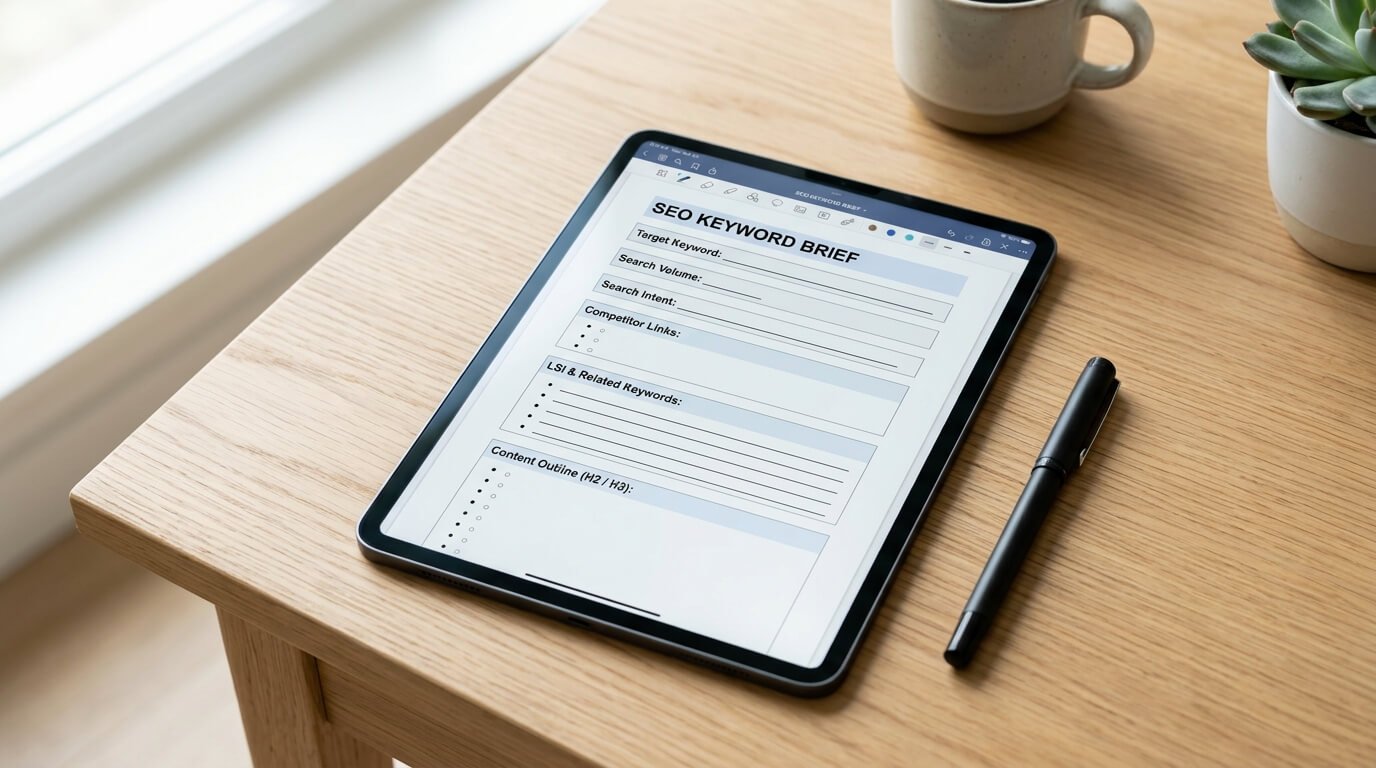
A useful brief is short and specific. It names one primary keyword that gives the page its main focus, plus a handful of secondary keywords, variations, and questions that support it. It describes the search intent, so the writer knows whether to write a guide, a list, or a comparison. It gives the target length and the reader’s level of knowledge.
Many briefs also set a minimum and maximum number of mentions for each keyword, add a short outline, list pages to link to, and note anything to avoid. You do not need every item for every article, so keep only the parts that will change how the writer writes.
How to Write a Keyword Brief Step by Step
The steps below work for a blog post, a service page, or a product guide. Follow them in order, because each step depends on the one before it.
Step 1: Define the Goal and the Audience
Start with one sentence about what the page should do and who it is for. For example, “Help new bloggers learn how to calculate keyword density, and lead them to a free checker.” This sentence keeps the rest of the brief honest. If a keyword or a section does not support the goal, it does not belong in the brief. Also note the reader’s level, because an article for beginners uses different words and examples than one for experienced SEOs.
Step 2: Pick the Primary Keyword
Choose one main phrase that matches what your reader types into Google. Check that people really search for it, that the page type you plan to write matches the top results, and that your site has a realistic chance to rank. Keep one primary keyword per page, and keep a simple list of which page owns which phrase, so two pages on your site do not compete with each other for the same search.
Step 3: Add Secondary Keywords and Questions
Collect a few supporting terms from autocomplete, the People Also Ask box, the headings of top results, and your own search data. Pick the ones that add something for the reader, such as a close variation, a related term, or a common question. Three to eight is a practical range for a typical article, and a short list you can use naturally is better than a long list you cannot. Remember that exact-match counters treat a plural and a singular as different words, so list the forms that matter.
Step 4: Describe the Search Intent
Write one or two lines about what the searcher wants. Do they want a quick definition, a step-by-step method, a comparison, or a tool? Say what kind of page ranks now, and what the new page should do better. This is the most skipped part of a brief and the most useful, because a page with perfect keyword use still fails if it gives the wrong kind of answer.
Step 5: Set Minimum and Maximum Mentions
For each keyword, choose the fewest times it should appear and the most times it can appear before it starts to sound forced. The next section explains how to pick these numbers. Treat them as editorial targets that you and your writer agree on, and not as rules from Google, because Google has not published an ideal number of mentions for any keyword.
Step 6: Add Structure, Links, and Notes
Finish with a rough outline, the target word count, and any pages to link to or sources to use. Add short notes on tone, such as “simple words, short examples, no hype”. If there are claims to avoid, such as ranking promises, say so here. A brief that fits on one page is more likely to be read and followed than a long document that nobody opens twice.
How to Set Sensible Minimums and Maximums

A simple habit works well. Set the minimum at the number of times the keyword needs to appear in the key places, which for a main phrase is often the title, the first paragraph, one subheading, and the conclusion.
Set the maximum at the point where the extra mentions would start to sound repetitive, which is often about twice the minimum. Long phrases appear fewer times than short single words, so a four-word primary keyword might sit at three to eight in a 1,500-word article, while a short term may sit higher. These are starting points for your own judgment, not fixed rules, so adjust them after you read the first draft.
A Keyword Brief Template
Copy this table into your own document and fill in each field. Delete any row that will not change how the article is written.
| Field | What to write |
|---|---|
| Goal | One sentence on what the page should achieve |
| Audience | Who is reading, and what they already know |
| Primary keyword | One main phrase, with the minimum and maximum mentions |
| Secondary keywords | Three to eight supporting phrases, each with a range |
| Questions to answer | Questions from autocomplete and People Also Ask |
| Search intent | What the searcher wants and the type of page that ranks |
| Length and format | Word count, headings, lists, or tables if needed |
| Links | Internal pages to link to, and trusted sources to cite |
| Tone and notes | Style, words to avoid, and claims not to make |
A Filled-In Example
Here is a short example for an article called “How to Calculate Keyword Density”. The goal is to help new bloggers learn the formula and try it on a real draft. The audience is beginners. The intent is a how-to guide with a worked example.
The length is about 1,500 words. The primary keyword and secondary keywords, with example ranges, are listed below in the format that a keyword brief checker reads.
how to calculate keyword density | 3 | 8
keyword density formula | 1 | 3
keyword density percentage | 1 | 3
keyword density example | 1 | 2
The ranges are only an example for this article, and the writer is free to ask for a change if a number does not fit the draft. The outline would include the formula, a worked example, phrase density, a common mistakes section, and a short FAQ.
How to Check a Draft Against the Brief
When the draft arrives, check it instead of counting by hand. Paste the text into the free Zuhio Keyword Count Checker, choose Keyword brief mode, and enter each keyword on its own line in the form term, minimum, maximum, separated by vertical bars.
The tool reports each keyword as Below minimum, Within range, or Above maximum, and shows the sentences where each one appears. The limits are inclusive whole numbers, so a count equal to your minimum or maximum counts as within range. Either limit can be left out, and a minimum that is higher than the maximum is reported as an error instead of being guessed.
What to Do When a Count Is Below or Above
If a keyword is below its minimum, look for places where it fits naturally, such as the introduction, a subheading, a conclusion, or an FAQ answer. Do not add it to random sentences. If it is above its maximum, read the flagged sentences out loud and keep the best mentions, then replace the rest with pronouns, short forms, or variations.
Remember that matching has no stemming, so “keyword” and “keywords” count separately, and add the variants you care about to the brief. A count that is one above or below a target is rarely worth a rewrite if the text reads well.
Mistakes to Avoid
Several mistakes make briefs less useful. Some briefs list too many keywords, so the writer cannot use them naturally. Others set tight ranges and treat them as strict rules, which leads to stiff text. Some skip search intent, copy a competitor’s headings without adding anything new, or forget to list the variants that a counter will not match on its own.
Another common mistake is presenting targets as Google’s recommendations. They are your team’s choices. Keep the brief short, explain the reasons behind each number, and let the writer’s judgment decide when the writing and the numbers disagree.
Tips for Working With Freelancers and Agencies
Send the brief before the writer starts, and ask for any questions in writing. Explain that the ranges are guides and that natural writing comes first. Include one or two examples of the tone you like, and say which claims to avoid.
When the draft comes back, check it with the same method every time, so feedback is based on facts and is easy to repeat. Share the results with the writer, including the sentences that caused a problem, because specific examples teach faster than general comments and make the next draft better.
Frequently Asked Questions
How long should a keyword brief be?
One page is enough for most articles. If a brief is longer than that, check whether every item really changes how the article is written.
Do I need a keyword brief for every article?
Not for short, casual posts that you write yourself. For client work, team projects, and important pages, a brief prevents most of the revisions that come from unclear goals.
Final Thoughts
A good keyword brief is short, specific, and honest about what it can and cannot do. Start with the goal and the reader, choose one primary keyword, add a few supporting phrases and questions, describe the search intent, and set simple minimum and maximum mentions that you and your writer agree on. Remember that these numbers are your own targets and not rules from Google, and let natural writing win when the two disagree.
When the draft is ready, paste it into the free Zuhio Keyword Count Checker, switch to Keyword brief mode, and see in seconds whether each keyword is below, within, or above its range. A clear brief saves time, reduces arguments, and helps every article start with a plan.