Introduction
Search engine optimization is an important part of building a successful website. When people search online, they use different forms of words to find information, products, and services. For example, one person may search for “write an article,” while another may search for “writing articles” or “writer.” These words are connected because they share a similar root and meaning. Understanding these word variations is useful for creating natural SEO content. This concept is known as keyword stemming. It helps writers understand how different forms of a word are connected and how they can use those forms in articles without repeating the same keyword again and again. Learning keyword stemming can improve your content-writing approach and help you cover a topic more naturally.
2. What Is Keyword Stemming?
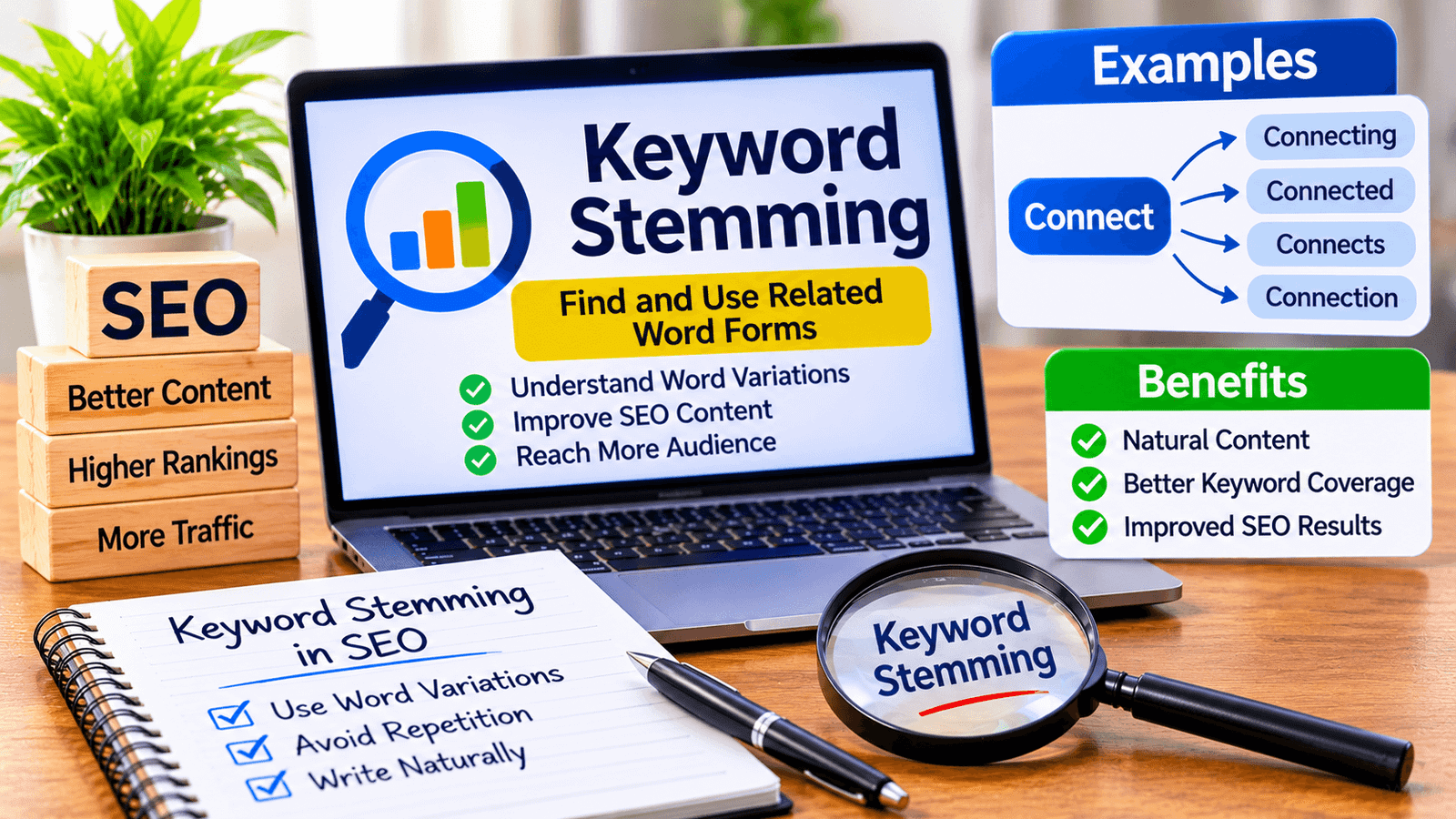
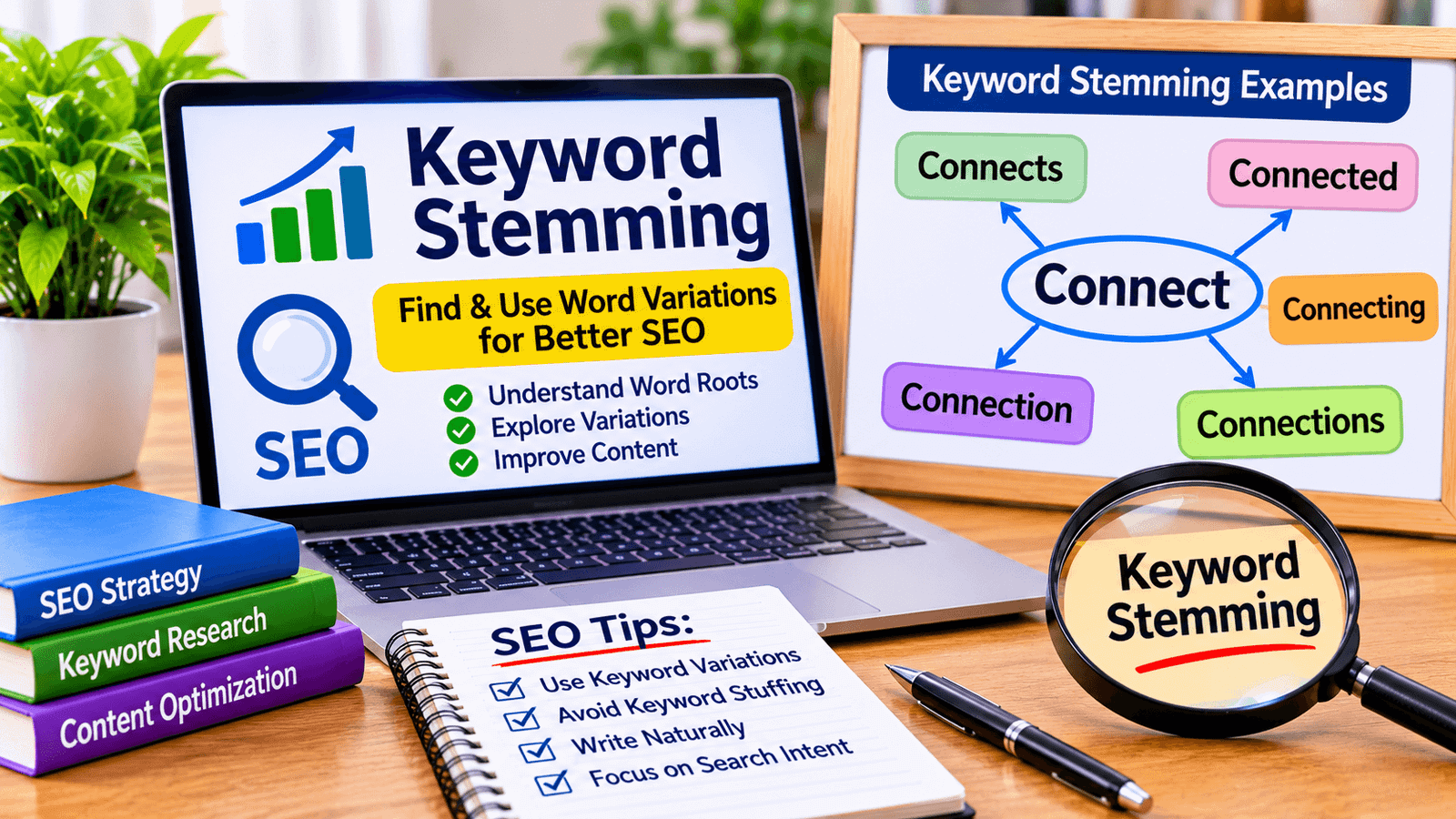
Keyword stemming is the process of identifying the root or base form of a word and connecting it with different variations of that word. These variations may include different endings, such as -ing, -ed, -s, or -er. For example, the words “connect,” “connected,” “connecting,” and “connection” are related in meaning, although they are not all created by exactly the same grammatical process. In SEO discussions, keyword stemming usually refers to understanding these related word forms when researching and writing content. It helps writers avoid relying on one exact phrase and encourages them to use language that sounds natural to readers.
3. Why Is Keyword Stemming Important for SEO?
Keyword stemming is useful because people do not always search using the same form of a word. Someone may search for “keyword checker,” while another person may search for “checking keywords” or “check keyword density.” These searches may have related purposes, even though their wording is different. Using natural word variations can help your content explain a topic in more complete language. It can also make writing less repetitive and easier to read. However, keyword stemming alone does not guarantee better rankings. Search engines consider meaning, relevance, search intent, content quality, and many other signals when deciding which pages to show.
4. How Does Keyword Stemming Work?
Keyword stemming works by connecting different forms of a word through a shared root or related meaning. For example, “play,” “plays,” “played,” and “playing” are common forms of the same base word. A search system may recognize that these words are closely related. This can help it understand pages even when the wording does not exactly match the search phrase. However, not every similar-looking word has the same meaning. The word “university,” for example, is related to “universities” through a plural form, but “universal” has a different meaning. Context is important when understanding how words relate to one another.
5. Examples of Keyword Stemming
Simple examples make keyword stemming easier to understand. Consider the base word “optimize.” Related forms include “optimizes,” “optimized,” and “optimizing.” Another example is “search,” which can appear as “searches,” “searched,” and “searching.” In an SEO article, you might use phrases such as “optimize your website,” “website optimization,” and “optimizing website content.” These phrases discuss connected ideas while making the writing more natural. The purpose is not to add every possible word variation to an article. Instead, use the forms that best explain the subject and match the language your readers understand.
6. Keyword Stemming vs. Keyword Lemmatization
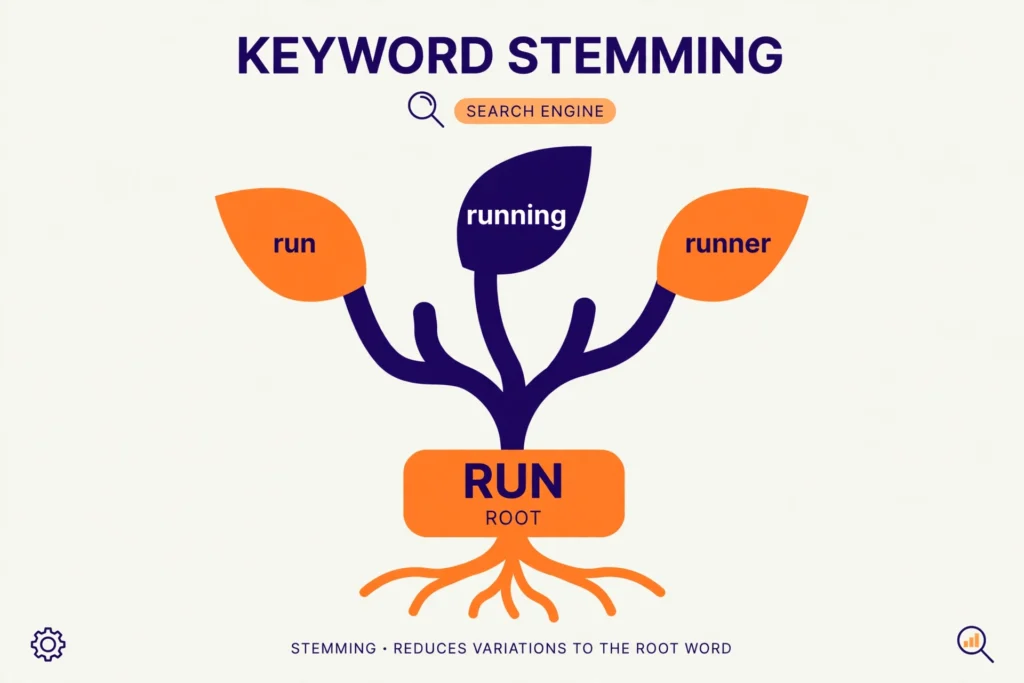
Keyword stemming and keyword lemmatization are related language-processing concepts, but they work differently. Stemming usually removes or changes word endings to identify a basic word stem. It may produce a shortened form that is not always a complete dictionary word. Lemmatization uses language rules and word meaning to identify the correct dictionary form, known as a lemma. For example, a stemming system may reduce a word to a basic stem, while a lemmatization system may identify its proper base form. Both methods can help computers process language, but they are not identical. Understanding this difference is useful when working with advanced SEO tools and natural language processing.
7. Benefits of Keyword Stemming
Keyword stemming can help content writers use different forms of words instead of repeating one exact keyword throughout an article. This makes sentences more natural and gives writers more flexibility when explaining a topic. It can also support keyword research by revealing variations that people may use in searches. For example, a page about “online writing tools” may naturally discuss writing, writers, editing, and written content. These terms help explain the wider subject. The biggest benefit is improved language variety and topic coverage, not an automatic ranking boost. Every variation should be relevant and useful to the reader.
8. How Keyword Stemming Helps Content Writers
Content writers often struggle with keyword repetition. When they focus too heavily on one phrase, their articles can sound unnatural. Keyword stemming offers a simple way to think about different forms of words and how they fit into sentences. For example, instead of repeatedly using “keyword optimization,” a writer can explain how to optimize a page, improve optimization, and create optimized content. These variations make the article easier to read. Writers should still check that each word fits the sentence correctly. A related word is not always a suitable replacement for the main keyword.
9. How to Find Keyword Variations
Start with your primary keyword and identify its base words. Then write down common variations, including singular and plural forms, verb forms, and related expressions. For example, if your main keyword is “keyword analysis,” you might research “analyze keywords,” “keyword analyzer,” and “analyzing keyword data.” Search suggestions and keyword research tools can provide additional ideas. Review each suggestion to understand whether it matches your article’s subject. Avoid selecting variations only because they contain similar letters. The meaning and search intent should remain relevant to your content.
10. Use Keyword Research Tools
Keyword research tools can help you discover related searches and variations of your main keyword. Platforms such as Google Keyword Planner, Ahrefs, and Semrush provide keyword ideas and other research information. Enter your primary phrase and review suggestions that match the subject of your article. Some tools also provide estimated search volume, competition, or keyword difficulty. These numbers are estimates and should be considered alongside relevance and search intent. Do not add every suggestion to your article. Select the terms that help explain your topic and answer questions your audience may have.
11. Use Google Search Suggestions
Google Search suggestions are another simple way to find keyword variations. Begin typing your main keyword into the search box and observe the phrases that appear. These suggestions can reveal common ways people complete a search. For example, typing “keyword stemming” may help you discover searches related to its meaning, examples, and SEO use. You can also review related searches on the results page. These ideas are useful for planning headings and FAQs. Remember that suggestions do not guarantee search volume or ranking opportunities. Always check whether the phrase is useful for your audience.
12. Use Keyword Stemming in Blog Titles
Your blog title should clearly explain what readers will learn. You can use a natural variation of your focus keyword when it makes the title more useful. For example, if your main keyword is “keyword stemming,” a suitable title could be “Keyword Stemming in SEO: Meaning, Examples, and Benefits.” Other pages might use related phrases such as “How Word Variations Work in SEO.” Keep titles accurate and avoid adding several variations just to increase keyword usage. A clear title helps readers understand the page before they open it.
13. Use Keyword Stemming in Headings
Headings divide your article into sections and help readers find information quickly. Use different forms of relevant words in headings when they accurately describe the content. For example, an article about keyword stemming could include headings such as “How to Find Keyword Variations” and “Benefits of Using Word Forms in SEO.” This creates a natural structure without repeating the same phrase in every heading. Organize headings logically with one main H1 heading and supporting H2 and H3 headings. Each heading should introduce information that is genuinely covered in the section below it.
14. Use Word Variations Naturally in Paragraphs
The best way to use keyword variations is to write sentences that sound natural. If your article discusses website optimization, you can use words such as optimize, optimized, and optimizing where they fit. Do not insert variations simply because they are on your keyword list. For example, “Optimizing your website can improve the experience for visitors” is clearer than a sentence that forces several versions of the same word together. Good content should explain ideas in a way that readers can understand. Natural language is more valuable than unnecessary keyword repetition.
15. Keyword Stemming and Long-Tail Keywords
Long-tail keywords are specific search phrases that often contain several words. Keyword stemming can help you discover variations within these phrases. For example, the main term “write content” may lead to searches such as “writing SEO content for beginners” or “how to write optimized blog posts.” These longer phrases can reveal specific questions and needs. Use them to plan useful sections, examples, and FAQs. Do not assume every long-tail phrase will bring traffic. Choose phrases that match your content and provide a clear answer to the searcher’s question.
16. Keyword Stemming and Search Intent
Search intent describes what a person wants to achieve when using a search engine. Word variations can sometimes indicate different purposes. For example, someone searching for “keyword analyzer” may want to use a tool, while someone searching for “how to analyze keywords” may want a tutorial. The words are related, but the expected results may be different. Before using a keyword variation, check what type of information people are looking for. A page should match the purpose of the search rather than simply include related words. Understanding intent helps you create content that is useful and relevant.
17. Common Keyword Stemming Mistakes
One common mistake is treating every similar-looking word as an interchangeable keyword. Words can share letters but have very different meanings. Another mistake is adding too many variations to one article, making the content repetitive and confusing. Some writers also believe that using every form of a keyword will automatically improve rankings. This is not true. Avoid unnatural sentences, unrelated variations, and keyword stuffing. Always check the meaning of a word before using it. If a variation does not help explain the topic, there is no reason to include it.
18. Keyword Stemming and Keyword Density
Keyword density measures how frequently a keyword appears in a piece of content compared with its total word count. Keyword stemming focuses on related forms of a word. These concepts can work together during content analysis, but they measure different things. For example, an article may contain the words “optimize,” “optimized,” and “optimization.” A keyword analysis tool may count these as separate terms or group them depending on its matching settings. Writers should understand how their tools process word variations. There is no universal keyword density percentage that guarantees better rankings.
19. How to Check Keyword Stemming in Content
You can review word variations manually or use a text analysis tool. First, identify your primary keyword and list its common forms. Then search your article for those forms to see how they are used. Check whether each variation makes sense in its sentence and whether it contributes useful information. Some keyword tools offer exact matching, partial matching, or word-form options. These settings can affect how phrases are counted. If your tool does not support stemming, you can still review the content manually. The most important task is making sure your article is clear and relevant.
20. Keyword Stemming in Modern Search Engines
Modern search engines use advanced language systems to understand queries and webpage content. They can consider context, related concepts, synonyms, word forms, and the overall meaning of a page. This means a useful article does not need to repeat the exact search phrase in every paragraph. However, writers should not assume that every variation will be treated as identical. Meaning depends on context, and some words have multiple uses. Focus on explaining the subject completely, using natural language, and answering the questions that visitors are likely to ask.
21. A Simple Keyword Stemming SEO Workflow
Follow this practical process when preparing an article:
- Choose your primary keyword: Select a phrase that describes the page.
- Find the base words: Identify the main words in the phrase.
- Research word variations: Look for common forms and related expressions.
- Check meanings: Make sure each variation fits the topic.
- Understand search intent: Review what users expect to find.
- Create an outline: Organize useful ideas into headings.
- Write naturally: Use relevant variations where they fit.
- Avoid repetition: Remove unnecessary keyword variations.
- Review your content: Check grammar, clarity, and relevance.
- Monitor performance: Use search data to improve the article over time.
This workflow makes keyword research easier and helps you create content that sounds natural rather than written only for search engines.

22. How to Measure the Success of Keyword Stemming
Do not measure the success of keyword stemming by counting how many word variations appear in an article. Instead, review the overall quality and performance of your content. Google Search Console can show which queries bring visitors to your website, along with impressions, clicks, and average search position. You may discover that your page appears for related searches that you did not include as exact phrases. Review those queries to understand whether your content answers the questions properly. Improve incomplete sections and update outdated information when necessary. Good SEO is an ongoing process, not a one-time keyword exercise.
23. Frequently Asked Questions About Keyword Stemming
What is keyword stemming in SEO?
Keyword stemming is the process of connecting different forms of a word through a common root or related meaning. It helps writers understand word variations when creating SEO content.
What is an example of keyword stemming?
Examples include “connect,” “connected,” “connecting,” and “connects.” These are different forms of the same base word.
Is keyword stemming important for SEO?
It is useful for understanding language variations and writing naturally. However, it is not a guaranteed Google ranking factor with a fixed score.
What is the difference between stemming and lemmatization?
Stemming usually reduces words to a basic stem by changing or removing endings. Lemmatization uses language rules to identify a proper dictionary form.
Should I use every keyword variation in my article?
No. Use only variations that fit the subject and help readers understand the information. Unnecessary variations can make content confusing.
Does keyword stemming prevent keyword stuffing?
It can encourage writers to use more natural language, but it does not automatically prevent keyword stuffing. You should still avoid unnecessary repetition.
Can keyword stemming help with keyword research?
Yes. It can help you discover different forms of a search term and understand how people may express related ideas.
24. Conclusion
Keyword stemming is a useful concept for understanding how different forms of words are connected in SEO content. It can help writers create natural sentences, discover keyword variations, and avoid repeating the same phrase unnecessarily. By researching related word forms, checking their meanings, and using them in the right context, you can create more complete and readable articles. However, keyword variations should never replace useful information or a clear content strategy. Focus on search intent, original explanations, and reader needs. These practices provide a stronger foundation for long-term SEO improvement.