Introduction
Anyone who writes for the web eventually asks the same question while staring at a finished draft: did I actually use my main keyword enough? Not too little, not too much, just enough for the page to feel clearly about what it’s supposed to be about. That question is exactly why a keyword count checker exists, and why so many writers quietly keep one open in another browser tab while they work.
This article breaks down what a keyword count checker actually does, why the idea behind it is still useful today, and how to use one without letting it take over your writing process.
What a Keyword Count Checker Actually Does
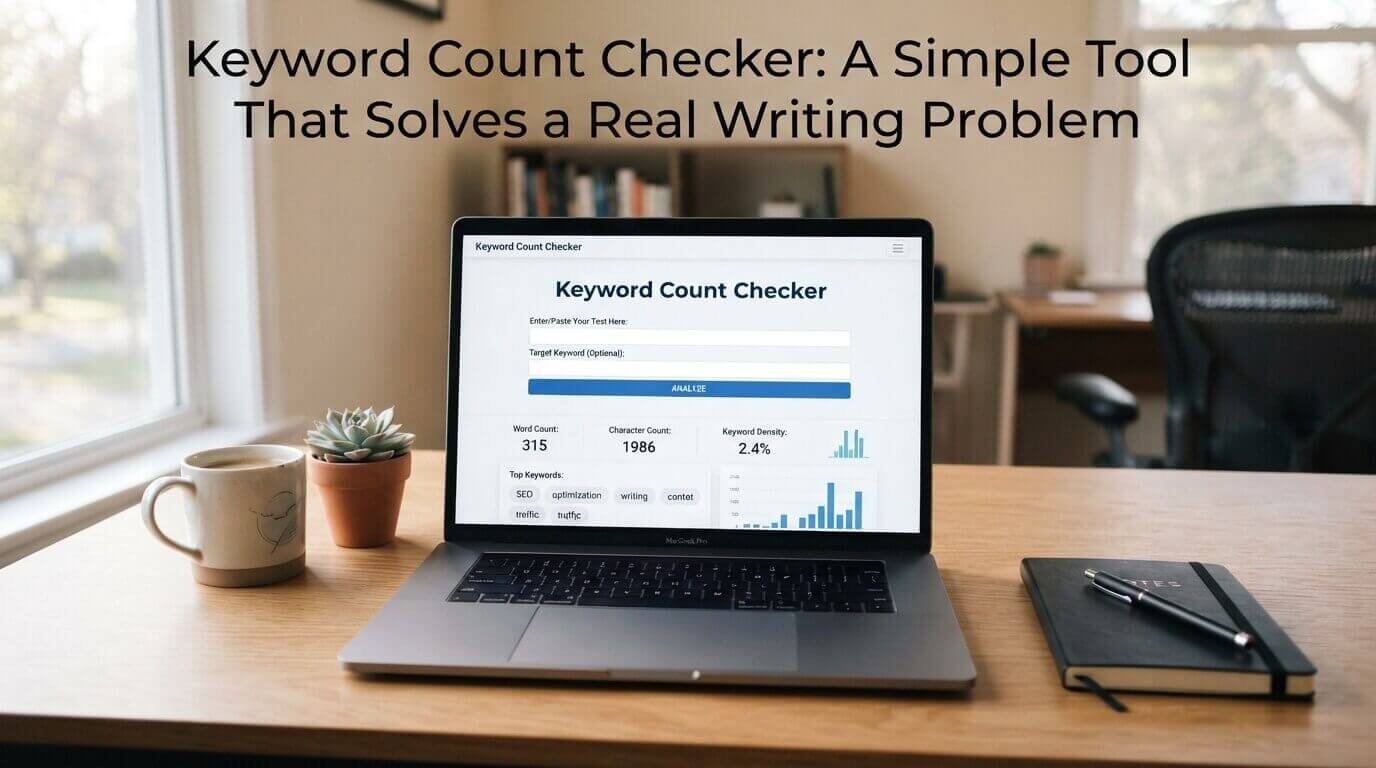
At its core, a keyword count checker does one job, and it does it well. You give it a block of text and a word or phrase, and it tells you exactly how many times that phrase shows up. No guessing, no manually scrolling through paragraphs trying to count on your fingers. Just a clear number, delivered in a second or two.
This sounds almost too simple to matter, but that simplicity is exactly why the tool is so widely used. Writers don’t always need a full SEO dashboard with dozens of metrics. Sometimes they just need one honest answer to one specific question.
Why People Still Search for a Keyword Count Checker

It might seem like an old-fashioned concept in an age of advanced AI writing assistants, but the demand for a straightforward keyword count checker hasn’t gone away. Bloggers still want to confirm their target phrase appears a reasonable number of times. Freelance writers still get client instructions asking for a keyword to be used “at least five times.” Store owners still want to check their product descriptions before publishing.
A keyword count checker answers all of these situations quickly, without requiring anyone to sign up for an account or learn a complicated interface first.
The Difference Between Keyword Count and Keyword Density
These two terms get used together so often that people sometimes assume they’re the same thing, but they measure slightly different ideas. Keyword count is the raw number — how many times a phrase literally appears in your text. Keyword density takes that number and compares it against your total word count, turning it into a percentage.
A good keyword count checker usually shows both numbers side by side, because raw count on its own can be misleading. Ten mentions of a phrase means something very different in a two-hundred-word product page than it does in a three-thousand-word guide.
How Search Engines Actually Think About Keyword Counts
Search engines today are far more sophisticated than simply scanning a page and tallying how many times a word appears. Modern algorithms try to understand meaning, context, and intent rather than rewarding raw repetition. Still, a keyword count checker remains useful because it helps confirm that your content is clearly, recognizably about the topic you’re trying to cover.
If a page never mentions its supposed topic in a natural way, that’s a real problem search engines can pick up on. A keyword count checker gives you a quick way to confirm you haven’t accidentally written around your topic without ever directly naming it.
Why Manual Counting Doesn’t Work Well
Before tools like this existed, writers had to either use their word processor’s find-and-replace feature or, worse, count manually while reading through a long article. Both approaches are slow and surprisingly error-prone. It’s easy to miss a mention buried in a long sentence, or accidentally count a plural form differently from the singular version of a word.
A dedicated keyword count checker removes all of that friction. It scans the entire text instantly and gives you a number you can actually trust, freeing up your time to focus on the writing itself rather than tedious counting.
Who Benefits Most From a Keyword Count Checker
While almost anyone writing online can find some use for this kind of tool, a few groups rely on it especially heavily.
Content Writers and Bloggers
Writers producing regular blog content use a keyword count checker as a final step before publishing, confirming their main topic is clearly represented without becoming repetitive.
SEO Freelancers
Freelancers juggling multiple client projects need a fast way to verify keyword instructions have been followed, especially when a client specifically requests a certain number of mentions.
Copywriters Working on Product Pages
Product descriptions are short by nature, which makes keyword count especially important. A single missed mention can be the difference between a page that clearly targets a search term and one that doesn’t.
Students and Long-Form Writers
Even outside of marketing, people writing long research papers or reports sometimes use a keyword count checker to confirm they haven’t overused a specific term throughout a lengthy document.
How to Use a Keyword Count Checker the Right Way
Getting the most out of one of these tools comes down to using it at the right stage of your writing process, not the wrong one.
Start by writing your full draft without thinking about the keyword count at all. Let your ideas flow naturally, the way you would if you were simply explaining the topic to someone in conversation. Once the draft feels complete, paste it into the keyword count checker and enter your target phrase exactly as you want it tracked. Review the number you get back, and then read through your content with fresh eyes, paying attention to sections where the keyword feels noticeably absent or oddly repeated.
Common Mistakes Writers Make With Keyword Counting
One of the most common mistakes is checking keyword count while you’re still drafting. This tends to interrupt your natural writing flow and often results in choppy, unnatural sentences built purely to fit the keyword in one more time.
Another mistake is treating the number from a keyword count checker as a strict quota rather than a helpful signal. If a sentence reads awkwardly because you forced in an extra mention just to hit a target number, it’s almost always better to rewrite the sentence naturally, even if that means the count ends up slightly lower than planned.
Why Long, Unnatural Repetition Hurts More Than It Helps
Readers notice repetition faster than most writers expect. A phrase that shows up too many times in a short space starts to feel robotic, and that feeling pushes readers away from finishing the page. Search engines have also become better at recognizing this pattern, meaning content stuffed with excessive repetition often performs worse, not better.
A keyword count checker helps you avoid this trap by giving you a concrete number to look at, instead of relying purely on gut feeling while you’re deep in the writing process and less able to judge your own repetition objectively.
Free Tools Versus Full SEO Platforms
It’s worth acknowledging what a simple keyword count checker can and can’t do. A dedicated tool focuses on one clear job: counting keyword mentions accurately and quickly. Full SEO platforms go much further, covering things like competitor research, backlink analysis, and keyword volume data pulled from real search engine statistics.
For the specific task of confirming how often a phrase appears in your writing, though, a focused keyword count checker does the job perfectly well, without requiring a paid subscription or a steep learning curve.
How Keyword Counting Fits Into Broader SEO Work
Counting keyword mentions is just one small piece of a much larger picture. Good SEO also depends on clear page titles, logical heading structure, fast loading times, and genuinely helpful content that actually answers what a reader is searching for. A keyword count checker supports one part of that process, but it was never designed to replace real research or thoughtful writing.
Combining a keyword count checker with a basic understanding of what your audience is actually searching for gives you a much stronger foundation than counting alone ever could.
Writing Naturally While Staying Aware of Your Keyword

The healthiest approach is to write your first draft freely, without worrying about the exact count at all. After finishing, read the piece out loud. If a keyword mention feels forced or interrupts the natural rhythm of a sentence, rewrite it, even if the number technically looks fine. Using close variations and related phrases throughout your writing also helps the content feel less repetitive while still clearly signaling your main topic.
A Short Note on What This Tool Can’t Promise
No keyword count checker, free or paid, can guarantee that a page will rank at the top of search results. Keyword count is one small signal among many, and actual rankings depend on competition, content depth, search intent, and a long list of other factors working together over time.
Final Thoughts on Using a Keyword Count Checker
A keyword count checker won’t write your article for you, and it certainly won’t guarantee first-page rankings on its own. What it offers instead is a quick, reliable answer to a question that’s genuinely difficult to judge just by rereading your own work. Used at the right moment, after a full draft is finished rather than while you’re still writing it, it helps catch both careless repetition and accidental keyword neglect before either one becomes something readers or search engines notice.
1 thought on “Keyword Count Checker: A Simple Tool That Solves a Real Writing Problem”